Pawn play is one difficult element in chess. Mastering the art of knowing what pawn you should move, and most important, when to do it, is definitely something that takes years to learn.
In this article we are going to have a look at a specific type of pawn play, the central ruptures.
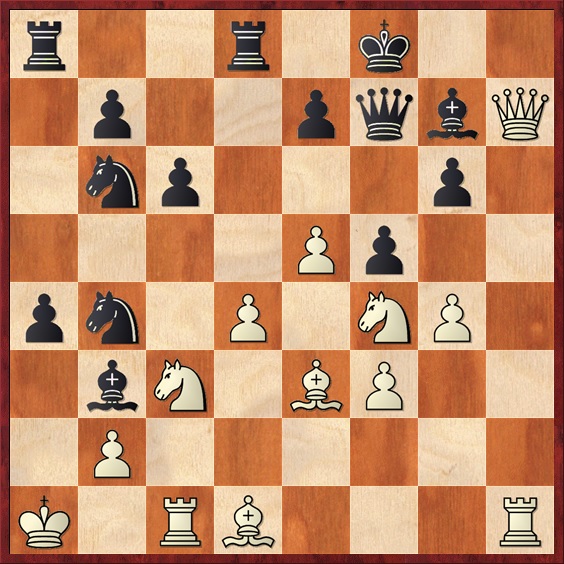
Motivated by Carlsen's game against Li Chao in the Qatar Masters taking place in Doha, we have decided to do a deeper research on the type of central break that Carlsen executed in that game. This game has to be one of the best games of the year 2015 for sure, but let's have a look at the last critical position:
Magnus Carlsen – Li Chao, Qatar 2015
The position is a total chaos, a complete mess. Both kings are exposed and if black manages to play his pawn to a3 he will be mating the white king in no time. On the other hand, white can give a check with his knight and grab a pawn on g6 at the same time, but after black moves his king there are no more checks and it is black who will take over the initiative with a4-a3.
Ready to start systematic training that actually works?
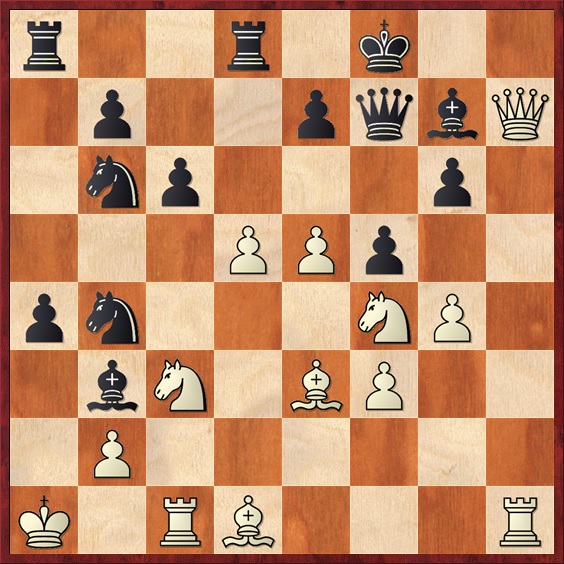
In this total chaos, Carlsen played a powerful move that gave white a winning advantage; the move is 24.d5!!
Magnus Carlsen – Li Chao, Qatar 2015
A wonderful move that opens the D file and, what's more important, it breaks the coordination among the black pieces. But let's take a brief moment to look at the position in the first diagram. There are 6 pieces (!) controlling the square d5 square. During a game, it is kind of difficult to think about such a move unless you're a skillful player, and even so, still difficult.
After 24.d5 white's attack becomes unstoppable and there are still some tricks for black, but Carlsen finished the game in great style.
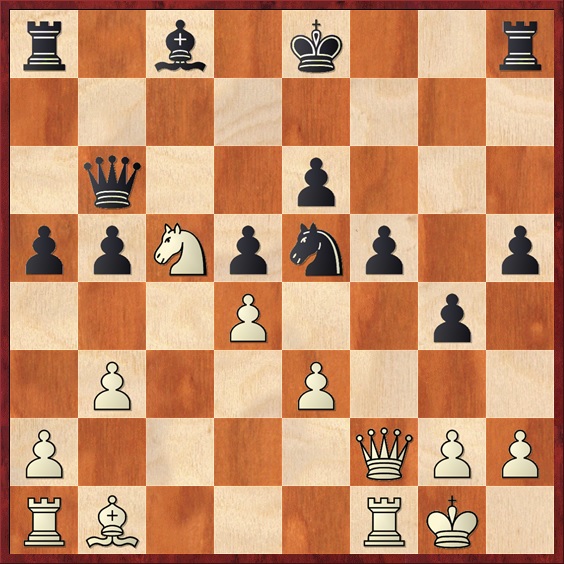
Continuing with stunning central ruptures, how many times you got the chance to push a pawn into a central square that your opponent has under full control (or so he might think)?. From my own practical experience, I can only recall one position, see the diagram below:
Castellanos,R – Garcia Roman,D, Mislata 2011
Black had just captured the pawn on e5 with his knight. If white takes the knight on e5 with his pawn then black takes the c5 knight and his king's situation in the center is of little importance with the position closed. However, white has a powerful move at his disposal. The move is 21.e4!! My opponent must have overlooked this move.
Having a pawn on f5 and another one on d5, it is difficult to foresee that white will be playing anything onto the square e4. However, as things turned out, black is defenseless after 21.e4. The queen is connected with the knight on c5 and white is threatening now to either take the knight on e5 or take on d5, both with a devastating effect.
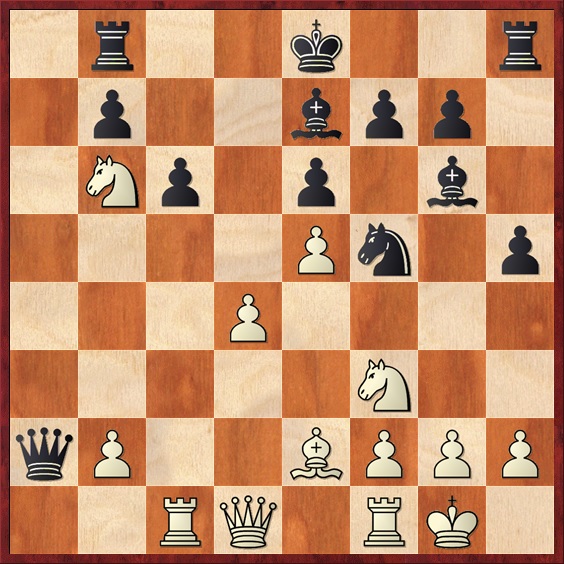
The following position occurred in the game between Grandmasters Sergey Rublevsky (white) versus Imre Hera (black). Black has just captured on a2. He has a solid structure and apparently he's doing fine. He’s got the two bishops and is one move away from castling, so what could go wrong? You guessed right! Rublevsky played 17.d5! with a demolishing attack! Again, a pawn moves to a square that the opponent has complete control over.
In conclusion, central pawn breaks must always be taken into serious consideration. They are usually a useful tool to open the lines and, as we have seen from the examples above, they tend to disrupt your opponent's piece coordination. It doesn’t matter how many pieces are controlling the critical square, many times not every piece can actually take your pawn on that square. An idea that you should definitely to keep in mind for your future games!
If you want to improve your chess level, you need to have a clear study plan. If you aim for a dramatic improvement at chessyou need to work on all of the elements of the game in a systematic way:
tactics
positional play
attacking skills
endgame technique
classical games analysis
psychological preparation
and much more
That seems to be like a lot of things, and that is. But no worries, we have made it easy for you. Our comprehensive training course covers it all and much more.
his article contains 5 important tips that will facilitate your chess learning and advancing. The material is prepared by a student of our Remote Chess Academy. He summarized the ideas that worked well for him. There’s a great chance that these tips will be helpful for you just as well.
Without further ado let me present an article of Louis Holtzhausen.
=-=-=-=-=-=-=-=-=-=-=-=-=-=-=-=-=-=-=-=-=-=-=-=-=
The tips are from the chess courses of GM Igor Smirnov
Chess Course Tip 1: The main idea of a chess game is activity
Isn’t it strange that even after studying a chess course – many chess players still can’t tell you what the main idea of a chess game is?
This is bad because how are you supposed to make good moves if you are not even sure what the main goals are? Once you know that you need to maximize the activity of your pieces, everything else will start to make a lot more sense.
Chess Course Tip 2: Study the middle game plans that relate to your opening
It is a common training mistake that many chess players make – they memorize many opening moves. To play the opening moves from memory can hardly give you any advantage over your opponent. But if you know the typical plans that arise from the opening you play, you can be much better prepared for the game!
When you train your opening moves – focus to understand the middle game plans that are typical to your opening. Training your opening moves in this way makes more sense and is also a lot more enjoyable than simply trying to memorize a lot of moves.
Chess Course Tip 3: Focus to improve your thinking process
Your knowledge about chess is notthe factor that will give you the edge in your games! Instead, knowing how to apply every bit of knowledge you have is the skill that will give you the edge.
In fact, too much knowledge will only confuse you if you don’t have a clear thinking system to help you apply all the things you have learnt.
Chess Course Tip 4: A master outplays his opponent with better positional understanding
Chess masters often avoid complications! Yes sure they are good even in complicated positions, but they also know that their main advantage is their deep understanding of chess positions.
A master will outplay their opponent. It will look as if the master wins easily without even doing anything special. This is simply because they have a deep understanding of the game and outplay their weaker opponent slowly but surely.
Chess Course Tip 5: Focus on the quality of your training instead of the quantity
I have been guilty of this training mistake myself too. Often chess players feel that they will improve by spending a lot of time training a whole lot of chess information. They will even spend hours solving tactical puzzle without seeing any real improvement in their results.
You will benefit more from studying one topic well (QUALITY) than to study many topics superficially(QUANTITY).
You can find more tips and information on his high quality chess courses by clicking this link: GM Smirnov’s chess courses (I only recommend chess courses that I have worked with myself and can highly recommend).
All chess players want to become masters, but only 1% succeed and the other 99% fail. Is that because they don’t have talent, necessary IQ level or some other master traits? Nope. The 99%don't reach the master level for a completely different set of reasons. Curious to find out why?
Most chess players don’t reach the master level for the following reasons:
1. They Don't Set Goals
Setting goals is very important part of achieving them. By setting a goal and a deadline for when it should be achieved you will keep yourself motivated and increase your chances of success by as much as 500%. Keep in mind that the goals should be realistic, meaning you shouldn't set a goal of becoming a Grandmaster in 3 month if you're currently 1400 rated. Nor should you set a goal of learning all 1000 endgames from the endgame manual by heart in a week or two.
The goal is there to motivate you, not to kill you. That's why picking an achievable goal is a very important step. After you have picked a realistic goal, you should document it. Take a piece of paper and write what your goal is, when you will achieve it and what happens if you don't achieve it on time.
For example, you can write that your goal is to solve no less than 3 tactics problems per day, every day for one month of time, starting month/day/year.
If you don't do that you will donate an extra 100$ (if that does not motivate you, you can go for 500 or 1000$) to the charity of your choice, won't be able to use your phone for specified number of day, watch your favorite TV show or some similar “punishment”.
By simply having a realistic, written goal, deadline and consequences in case you fail to achieve it you will set yourself for success.
2. They Don't Plan Their Training
Most chess players are training spontaneously, by randomly working on different aspects of chess that they feel comfortable with. Nothing is wrong with this approach, except that it usually doesn't lead to improvement.
Wouldn't it be great to improve your tactical vision so that you could see all of the threats 10 moves ahead?
Wouldn't it be nice to study the endgames so that you don't have to take chances when playing those Rook and Pawn endings?
Wouldn't it be helpful to learn some positional game ideas as well as some attacking techniques? And indeed it would be nice to brush off your opening preparation, so that you don't end up in these losing middlegames.
Surprisingly most chess players know what they need to be doing, but somehow they don't do it. Having a precise study plan, that will keep you motivated and focused while providing you with the right resources will help you to become a better player.
3. They Don't Schedule Their Time
Once you have the goal and the training plan it does not mean that you will automatically improve your game. You need to put the work first. And in order to do that, you need to schedule your day, so that you always have time to stick to the plan.
You will be much more likely to commit to a certain activity like jogging, weight-lifting or becoming a chess master if you schedule when you will do that. For example, you may train for 5 days per week from 8 to 9 am. Being consistent and working on chess in step-by-step manner will get you where you need to be.
4. They Don't Track Progress
Having some sort of analytics or in other words tracking your chess improvement progress is very important if you want to become a stronger player. Writing down what problems you did, which ones you've solved correctly and which ones you didn't is very important for realizing what you understand and what you don't.
The same goes to the games you play. You need to track in what kind of openings/middlegames/endgames you perform best and worst at. Then, you need to make appropriate adjustments to fix your weaknesses and build on your strengths.
5. They Don't Make Changes
Last, but not least, alternating your training routine once a month or so will help you to avoid the plateau in your chess. Have you noticed how easy it is to improve at first? While you're lower rated, you can easily pickup as many as 200-300 points in matter of months.
Then, when you get stronger at chess, improving tends to become more difficult, partly because your brain gets used to the exercises you typically perform. Therefore, alternating your routine is crucial to avoid plateauing on the certain level.
If you want to improve your chess level, you need to have a clear study plan. If you aim for a dramatic improvement at chessyou need to work on all of the elements of the game in a systematic way:
tactics
positional play
attacking skills
endgame technique
classical games analysis
psychological preparation
and much more
That seems to be like a lot of things, and that is. But no worries, we have made it easy for you. Our comprehensive training course covers it all and much more. Sign up for 21 Day Training right now!
there will be a MASSIVE 30% discount on all the RCA products! This discount is valid from today until Saturday, 31 October (inclusive). You can use the coupon “igor28” when making your purchase. Check here if you don’t know how to use a discount code. Second, we have released the second part of the premium video “Killer Endgames” by GM Nick Pert (a premium video from our partner, GM Simon Williams).
We released “Killer Endgames Part-1” for you, in the month of August. We received a lot of feedback from the students – many students (someone like YOU) liked the premium video. So, we have made the best foot forward and continue to provide you with what you like.
Don’t forget that you can get this premium video with the above-mentioned 30% discount! Just use the coupon “igor28”.
Moreover, there is another special offer, you can get. If you purchase the premium video, “Killer Endgames Part-2” by GM Nick Pert, you will get the RCA premium video, “Typical Mistakes in Practical Middlegame and Endings” (worth $15) completely FREE.
Additionally, we are doing our best to make the paper version of my book, A Promoted Pawn: My Chess Journey, available, and most likely it will be so. Since there are special offers in honor of my birthday, you will be able to purchase the book with a good discount.
Note: if you have already purchased the book in e-book format, you will just have to pay for the paper version (i.e. You need NOT pay for the actual book’s cost)
Also, we’re planning to sell the book during my next seminar in Trissur. You can get the book from me along with my autograph. If you would like to attend my seminar, just reserve your seat now here.
Many chess players wish to know if they will ever become Grandmasters. There are many exams available that can estimate your current strength, but none can tell you whether you can become a GM or not. Today we have compiled a short list of very important signs that may suggest you have a real potential for obtaining the highest chess title. Curious to find out if that’s about you? Read on!
1. Well-developed chess intuition
All grandmasters have a well-developed chess intuition. That means even without analyzing the position, GMs already know what's happening on the board, what side is winning and what move each player should play.
That won't be a 100% accurate analysis, like you will get if you calculate all of the variations or plug in the position into an engine. Nevertheless, it is a fairly accurate evaluation that can be used to make decisions during the game.
Another sign that you have a well-developed chess intuition is ability of guessing GM's moves during the game. It is very easy to check. Start watching any high level chess game and try guessing what moves one or another player will make. If the percentage of the moves you’ve guessed correctly is high, congratulations, you already may have a well-developed chess intuition.
2. Great memory for chess positions and patterns
Another very important thing for a strong player is a good memory for chess positions and patterns. Many grandmasters keep 100s if not 1000s of classical games in their heads.
Ability to memorize positions and games is extremely useful when it comes to preparation of openings, endgames or playing a typical middlegames. Grandmasters remember many classical games dealing with all sorts of pawn structures, endgames, tactical motifs, weaknesses, attacking schemes and so on.
If you have a good chess memory, you can put yourself a big plus on the potential grandmasters' checklist.
3. Superior visualization skills
Visualization is probably the single most important skill that a grandmaster needs because it is directly related to tactics. Without the ability to visualize positions, after certain moves are made and some pieces are captures, it is next to impossible to become a strong tactical player.
Visualization skills help tremendously at finding the correct tactics, calculating lines, planning the game and even finishing off the simple endgames. If you have strong visualization skills, your chances of becoming a grandmaster are much higher than for those who don't.
4. Ability to work on chess for hours
Even if you have all necessary prerequisites for becoming a grandmaster, you won't become one unless you spend a lot of time working on chess and perfecting your game. You see, even the most gifted chess players such as Magnus Carlsen, need to spend years to develop their talent.
That's why the ability to work on the game consistently, without getting bored and tired is crucial for becoming an elite chess player.
5. High level of competitiveness
Without a high level of competitiveness and a strong drive for becoming a better chess player it is not possible to progress. Some of the most competitive chess players such as Bobby Fischer and Garry Kasparov are also the most successful ones in history of the game.
If you want to become a grandmaster you must be competitive, you must try to win every single position against every single opponent you face. You should take each defeat as an opportunity to patch your preparation holes, to return and win.
6. Ability to stay focused for extended periods of time
Chess matches can be long, extremely long. Any grandmaster has played games which lasted for 6-7 hours non-stop. These kinds of games are exhausting and drain you both mentally and physically. In order to win such games you need to preserve energy and stay focused for the whole time. Any mistake can end the game not in your favor.
If you want to become a grandmaster you should be able to stay focused for very long periods of time. You need to learn making the best moves, even when you're tired or totally exhausted. Only then you can win games against stronger competition and be on your way to breaking that magical 2500.
7. Ability to perform well under pressure
It is a fact that defending in chess is much harder than attacking. There is a lot more at stake when your king is under pressure. You can get checkmated and the game will be over instantly. Any chess player ends up in terrible position sooner or later. It takes a true talent and courage not to give up and to pull yourself out of the losing position.
It is not possible to become a grandmaster without the ability to save lost games. You need to learn playing your best chess under pressure, even when you are down in material or under a serious attack. That will save you many games, and will gain you plenty of rating points.
Is it enough for becoming a grandmaster? It is no way to know. But if you can do it, the chances are you can become a GM someday.
If you want to improve your chess level, you need to have a clear study plan. If you aim for a dramatic improvement at chess you need to work on all of the elements of the game in a systematic way:
tactics
positional play
attacking skills
endgame technique
classical games analysis
psychological preparation
and much more...
This book is not about how I became a Grandmaster..
This book is not about how I became a Grandmaster..
..rather, about how a GM overcame various obstacles in his chess journey.
This book summarizes the most valuable lessons from 20+ years of GM Smirnov's extensive chess practice, both as a player and a coach.
You'll learn what does work best for your chess progress. Also, you'll be warned of typical pitfalls or will see the way out if you already stuck.
Finally, you'll definitely enjoy reading a book full of interesting stories and witty advice. It may give a whole new meaning to your own chess study...
There will be a lot of advice, but also a lot of truth
There are many twists and turns down the road to chess strength and improvement. Chess students are told many things, and not all of them are correct. Some things are actually flat out wrong.
This same information gets passed down generation after generation and players don’t get any better. I hope to help the reader navigate through some of these pitfalls and steer them along the better parts of the road for smoother travel.
Today is a great day – hurray, our new book, Champion Psychology – a book for future chess champions, has been released for you!
Firstly, I’d like to thank everyone who has sent me theirquestions about this topic– they are themain reasonfor this book! Also, thank you for your patience over the release of this book.
Let me remind you about the special offers that I’ve provided for you:
The first 100 buyers will get a FREE attendance (and also a recording) at my webinar “Press your opponents like Carlsen“.
Remaining buyers until 27 Feb. will receive the recording of my webinar “Press your opponents like Carlsen“.
Moreover, there will be a 25% discount on the book – and the discount code is champ25
NOTE: We’ll contact you at your e-mail address (used for the purchase) to send you the FREE invitation (or recording).
As I said, our subscribers were informed about the discount coupon in advance. Therefore, the countdown to the first 100 buyers has already started. Taking into account around 20,000 of our subscribers, 100seem to be a very small number, right? Then, hurry up and get the book now if you want my webinar recording for FREE!
Note: the discount code champ25 is valid from 25 Feb. to 1 Mar. inclusive only. If you don’t know how to use a discount code, please see here: LINK
Also, you can watch the video explaining the offers below:
If you don’t know how place an order, please see here: LINK
Moreover, we’re publishing the book ine-book format only and not in paper as of now. Therefore, if you would like the book inprinted version, then feel free to write your comments below or by contacting us here: LINK
Also, you would not need to pay the full price again for the paper version (if we print it) but just the additional costthat this would require. In any case, we’ll be very happy to know your thoughts. So don’t forget to let us know your needs by contacting us (LINK).




 Check
Check  Second, we have released the
 Note: if you have already purchased the book in e-book format, you will just have to pay for the paper version (i.e. You need NOT pay for the actual book’s cost)


