Showing posts with label buy chess set online. Show all posts

Friday, 1 January 2016

Power Moves: The Pawns play

Pawn play is one difficult element in chess. Mastering the art of knowing what pawn you should move, and most important, when to do it, is definitely something that takes years to learn.
In this article we are going to have a look at a specific type of pawn play, the central ruptures.
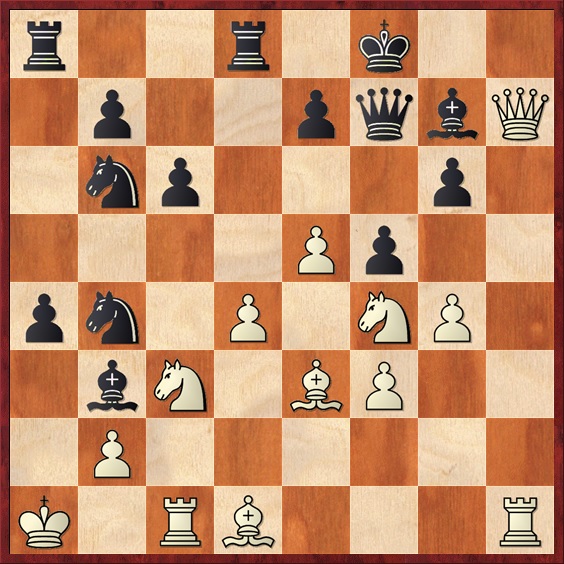
Motivated by Carlsen's game against Li Chao in the Qatar Masters taking place in Doha, we have decided to do a deeper research on the type of central break that Carlsen executed in that game. This game has to be one of the best games of the year 2015 for sure, but let's have a look at the last critical position:
central pawn break
Magnus Carlsen – Li Chao, Qatar 2015
The position is a total chaos, a complete mess. Both kings are exposed and if black manages to play his pawn to a3 he will be mating the white king in no time. On the other hand, white can give a check with his knight and grab a pawn on g6 at the same time, but after black moves his king there are no more checks and it is black who will take over the initiative with a4-a3.
Ready to start systematic training that actually works? 
start chess training
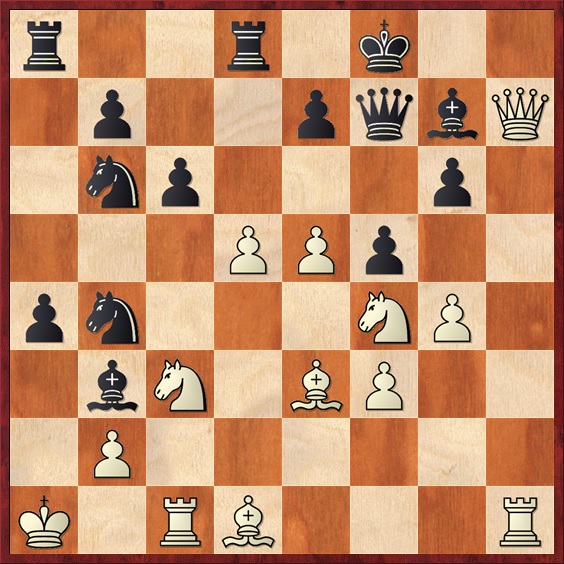
In this total chaos, Carlsen played a powerful move that gave white a winning advantage; the move is 24.d5!!
central pawn break
Magnus Carlsen – Li Chao, Qatar 2015 
A wonderful move that opens the D file and, what's more important, it breaks the coordination among the black pieces. But let's take a brief moment to look at the position in the first diagram. There are 6 pieces (!) controlling the square d5 square. During a game, it is kind of difficult to think about such a move unless you're a skillful player, and even so, still difficult.
After 24.d5 white's attack becomes unstoppable and there are still some tricks for black, but Carlsen finished the game in great style. 
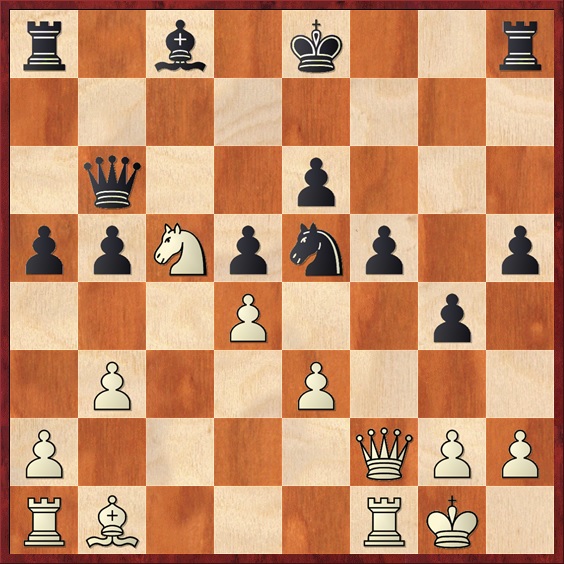
Continuing with stunning central ruptures, how many times you got the chance to push a pawn into a central square that your opponent has under full control (or so he might think)?. From my own practical experience, I can only recall one position, see the diagram below:
central pawn break
Castellanos,R – Garcia Roman,D, Mislata 2011
Black had just captured the pawn on e5 with his knight. If white takes the knight on e5 with his pawn then black takes the c5 knight and his king's situation in the center is of little importance with the position closed. However, white has a powerful move at his disposal. The move is 21.e4!! My opponent must have overlooked this move.
Having a pawn on f5 and another one on d5, it is difficult to foresee that white will be playing anything onto the square e4. However, as things turned out, black is defenseless after 21.e4. The queen is connected with the knight on c5 and white is threatening now to either take the knight on e5 or take on d5, both with a devastating effect. 
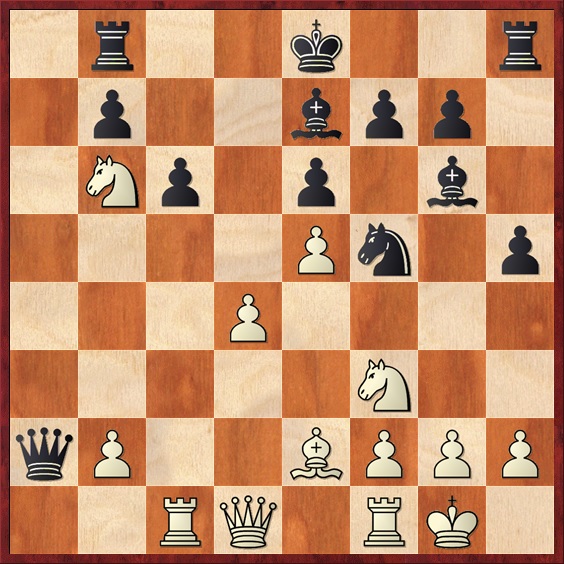
central pawn break
The following position occurred in the game between Grandmasters Sergey Rublevsky (white) versus Imre Hera (black). Black has just captured on a2. He has a solid structure and apparently he's doing fine. He’s got the two bishops and is one move away from castling, so what could go wrong? You guessed right! Rublevsky played 17.d5! with a demolishing attack! Again, a pawn moves to a square that the opponent has complete control over.
In conclusion, central pawn breaks must always be taken into serious consideration. They are usually a useful tool to open the lines and, as we have seen from the examples above, they tend to disrupt your opponent's piece coordination. It doesn’t matter how many pieces are controlling the critical square, many times not every piece can actually take your pawn on that square. An idea that you should definitely to keep in mind for your future games!
If you want to improve your chess level, you need to have a clear study plan. If you aim for a dramatic improvement at chessyou need to work on all of the elements of the game in a systematic way:
  • tactics
  • positional play
  • attacking skills
  • endgame technique
  • classical games analysis
  • psychological preparation
  • and much more
That seems to be like a lot of things, and that is. But no worries, we have made it easy for you. Our comprehensive training course covers it all and much more. 

Thursday, 29 October 2015

Grand Master birthday and exciting offers!

there will be a MASSIVE 30% discount on all the RCA products! This discount is valid from today until Saturday, 31 October (inclusive). You can use the coupon “igor28” when making your purchase.
30% discountCheck here if you don’t know how to use a discount code.
designSecond, we have released the second part of the premium video “Killer Endgames” by GM Nick Pert (a premium video from our partner, GM Simon Williams).

We released “Killer Endgames Part-1” for you, in the month of August. We received a lot of feedback from the students – many students (someone like YOU) liked the premium video. So, we have made the best foot forward and continue to provide you with what you like.

Don’t forget that you can get this premium video with the above-mentioned 30% discount! Just use the coupon “igor28”.

Moreover, there is another special offer, you can get. If you purchase the premium video, “Killer Endgames Part-2” by GM Nick Pert, you will get the RCA premium video, “Typical Mistakes in Practical Middlegame and Endings” (worth $15) completely FREE. 
  • Number of DVDs – 1
  • Number of files to download – 2
  • How to decompress split zip files? – check here
Additionally, we are doing our best to make the paper version of my book, A Promoted Pawn: My Chess Journey, available, and most likely it will be so. Since there are special offers in honor of my birthday, you will be able to purchase the book with a good discount.
Note: if you have already purchased the book in e-book format, you will just have to pay for the paper version (i.e. You need NOT pay for the actual book’s cost)
Also, we’re planning to sell the book during my next seminar in Trissur. You can get the book from me along with my autograph. If you would like to attend my seminar, just reserve your seat now here.


Sunday, 18 October 2015

5 Steps for Calculating Like a Grandmaster

All chess players know that grandmasters can calculate many moves ahead, evaluate the position, and deliver the final blow. How do they do that? Is there a way an ordinary chess player can learn to calculate many moves ahead like masters do? In this article, we will answer those questions and show you a simple schematic that will tremendously help at calculating moves.
 

Step 1. Knowing when and what to calculate
The most important step in move calculation is actually to know when you need to calculate the variation and when you don’t.Chess players, even very strong Grandmasters, are not machines. They cannot simply calculate all lines and come up with the best continuation.
That’s why it is very important to realize when you need to calculate the line. The primary difference between a strong and a weak player is not how much each player calculates. The main difference between the two is in the ability of each player to find the right moves to calculate in the first place.
There are no general guidelines as of when and what you need to calculate. But I will try to give you some basic suggestions that will help you at deciding when you should calculate the variation:
1. When your own king or your opponent’s king is under attack, you should calculate the possibilities to end or continue the attack.
2. When there are many pieces/pawns under attack you should calculate the possibilities to win/save the pieces/pawns.
3. When the position is unstable (possible exchanges, pawns structure changes, simplifications etc.) you should calculate how you can benefit the most from it.
Step 2. Finding the candidate moves
After figuring out what and when to calculate you should find the so-called candidate moves. These are the moves that will most likely lead to the most favorable outcome. They generally make sense based on the current positional evaluation. After identifying3-4 candidate moves you should start calculating the lines, starting with what you think is the strongest candidate move.
The ability to calculate these lines solely depends on your calculation and visualization skills that can be enhanced by special exercises.
Ready to start systematic training that actually works? 
start chess training
Step 3. Evaluating the position
After you have finished calculating the line based on selected candidate moves, you have arrived to a certain final position. In order to judge if the move was a good one or not, it is necessary to evaluate this position and to understand if you’ve achieved some improvement on the board.
This evaluation possesses additional challenges because you cannot see the position on the board, and need to evaluate it only based on your visualization ability.
Step  4. Using method of elimination
In order to make your life simpler, it is crucial to decrease the number of moves and variations that you need to calculate and analyze. If you start calculation of the line and notice that there are already many problems after move 3, there is no need to continue the calculation. Save some time and use it where it needed the most.
Chess is not a game for a perfectionist, by rather for a player who knows how to spend his resources wisely. You goal is to eliminate all bad possibilities and to calculate/play only the good moves.
Step  5. Making the final decision
The final step is probably the easiest of all five. You need to critically look at your analysis and select a single best move to play in the game. If you encounter two or more moves which are about the same quality, you can go ahead and play any of the two. It doesn’t need to be perfect, but it should be a good move.
After you have selected the move you will play, it makes sense to double check the line and to make sure that you are not making a mistake. When that is done, you can go ahead and play the move. If you did everything correctly, your position should slightly improve.

Saturday, 3 October 2015

7 Signs You Have a Potential for Becoming Grandmaster

Many chess players wish to know if they will ever become Grandmasters. There are many exams available that can estimate your current strength, but none can tell you whether you can become a GM or not. Today we have compiled a short list of very important signs that may suggest you have a real potential for obtaining the highest chess title. Curious to find out if that’s about you? Read on!


1. Well-developed chess intuition
All grandmasters have a well-developed chess intuition. That means even without analyzing the position, GMs already know what's happening on the board, what side is winning and what move each player should play.
That won't be a 100% accurate analysis, like you will get if you calculate all of the variations or plug in the position into an engine. Nevertheless, it is a fairly accurate evaluation that can be used to make decisions during the game.
Another sign that you have a well-developed chess intuition is ability of guessing GM's moves during the game. It is very easy to check. Start watching any high level chess game and try guessing what moves one or another player will make. If the percentage of the moves you’ve guessed correctly is high, congratulations, you already may have a well-developed chess intuition.
2. Great memory for chess positions and patterns
Another very important thing for a strong player is a good memory for chess positions and patterns. Many grandmasters keep 100s if not 1000s of classical games in their heads.
Ability to memorize positions and games is extremely useful when it comes to preparation of openings, endgames or playing a typical middlegames. Grandmasters remember many classical games dealing with all sorts of pawn structures, endgames, tactical motifs, weaknesses, attacking schemes and so on.
If you have a good chess memory, you can put yourself a big plus on the potential grandmasters' checklist.
 

3. Superior visualization skills
Visualization is probably the single most important skill that a grandmaster needs because it is directly related to tactics. Without the ability to visualize positions, after certain moves are made and some pieces are captures, it is next to impossible to become a strong tactical player.
Visualization skills help tremendously at finding the correct tactics, calculating lines, planning the game and even finishing off the simple endgames. If you have strong visualization skills, your chances of becoming a grandmaster are much higher than for those who don't.
4. Ability to work on chess for hours
Even if you have all necessary prerequisites for becoming a grandmaster, you won't become one unless you spend a lot of time working on chess and perfecting your game. You see, even the most gifted chess players such as Magnus Carlsen, need to spend years to develop their talent.
That's why the ability to work on the game consistently, without getting bored and tired is crucial for becoming an elite chess player.
5. High level of competitiveness
Without a high level of competitiveness and a strong drive for becoming a better chess player it is not possible to progress. Some of the most competitive chess players such as Bobby Fischer and Garry Kasparov are also the most successful ones in history of the game.
If you want to become a grandmaster you must be competitive, you must try to win every single position against every single opponent you face. You should take each defeat as an opportunity to patch your preparation holes, to return and win.
6. Ability to stay focused for extended periods of time
Chess matches can be long, extremely long. Any grandmaster has played games which lasted for 6-7 hours non-stop. These kinds of games are exhausting and drain you both mentally and physically. In order to win such games you need to preserve energy and stay focused for the whole time. Any mistake can end the game not in your favor.
If you want to become a grandmaster you should be able to stay focused for very long periods of time. You need to learn making the best moves, even when you're tired or totally exhausted. Only then you can win games against stronger competition and be on your way to breaking that magical 2500.
7. Ability to perform well under pressure
It is a fact that defending in chess is much harder than attacking. There is a lot more at stake when your king is under pressure. You can get checkmated and the game will be over instantly. Any chess player ends up in terrible position sooner or later. It takes a true talent and courage not to give up and to pull yourself out of the losing position.
It is not possible to become a grandmaster without the ability to save lost games. You need to learn playing your best chess under pressure, even when you are down in material or under a serious attack. That will save you many games, and will gain you plenty of rating points.
Is it enough for becoming a grandmaster? It is no way to know. But if you can do it, the chances are you can become a GM someday.
If you want to improve your chess level, you need to have a clear study plan. If you aim for a dramatic improvement at chess you need to work on all of the elements of the game in a systematic way:
  • tactics
  • positional play
  • attacking skills
  • endgame technique
  • classical games analysis
  • psychological preparation
  • and much more...

This book is not about how I became a Grandmaster..


Wednesday, 28 January 2015

How to become a Blitz Master and offers on the new course

First, let me ask you a few questions – have you ever played blitz chesstournaments in your club or on the Internet? Have you won some good gamesand tournaments in blitz? Were you finding a steady increase in your progress?
 
If your answer is “No” or uncertain – then your results will be unstable.
That is because you need to have a sharp mind to calculate a lot of moves within a few seconds. And this can be done only by repetitive practice and experience.
 clock
Not even all grandmasters have stable results – there are only few GMs like Fischer, Morphy, Tal, Capablanca and Anand who can be recognised as a ‘Blitz Master’.
blitzmasters
Only the person who has more knowledge on a certain topic, an expert on that topic, can teach it. Therefore, we’ve invited a ‘Blitz Master’ to teach you thoseskills; you can learn and, more importantly, incorporate them into your games and become a ‘Blitz Master’ too! :)
I’m very glad to announce that the next webinar will be conducted by GM Maxim Dlugy (the main author of the new course) on Friday 30 Jan. at 3 p.m. GMT (check timings here: LINK).
dlugy
Yes, GM Dlugy is an extraordinary blitz player – he has an incredible top rating of 2731 in blitz! Also, GM Dlugy was the world’s highest ranked in blitz, according to WBCA ratings, a ranking he held for four consecutive years!
webinar

<<Sign up for the webinar now>>

In Friday’s webinar, “How to become a Blitz Master?”, GM Dlugy will teach you the 26 secrets of playing blitz well, while analysing his victories against the best players in the world.
design
In the previous article, I shared with you a short introductory video on the new course, “Unlocking the Grandmaster’s Mind”, and revealed almost everything about the course (if you missed that, check it now: LINK).
Today, I’ve something exciting for you. As I promised that the new course would be ready this month, I’m very glad to announce that it will be released on 29thJan:)
cover
But wait, I still have something good for you – yes, I’m going to provide you with some great discounts and special offers to celebrate this special occasion! :)
offer
DISCOUNT:
I’m going to provide you with two discount coupons this time!
The first 100 buyers will be offered a 30% DISCOUNT on the new course! Subsequent buyers will get a 20% DISCOUNT only:)
discount
Also, a few hours in advance I’ll reveal the discount coupon to those students who have subscribed to our newsletter – Quick Success in Chess (LINK). So if you are asubscriber, you have more chances to be among the first 100 buyers and get a30% discount!
If you haven’t yet subscribed to us, you can surely do so now: LINK
NOTE: the discount coupon is valid from 29th Jan. to 1st Feb. (inclusive) only. To learn how to use a discount code, see here: LINK
SPECIAL OFFER:
Do you want to attend the above-mentioned GM Dlugy’s webinar on Friday 30 Jan for FREE? Yes, you can get FREE attendance for the webinar! :)
 free
If you buy the course, “Unlocking the Grandmaster’s Mind”, on 29 Jan., you can attend GM Dlugy’s webinar, “How to become a ‘Blitz Master?”, on the 30th forFREE!
I’ve also prepared a video explaining the offers in detail. You can watch it below: 


Monday, 15 December 2014

10 Reasons Why Adult Players Fail to Improve at Chess


1. Lack of Motivation
Surprisingly, lack of motivation, is the biggest progress stopper at chess and life alike. Many adult players are simply not motivated enough to get better at chess. They want to improve their game, but they don’t want it bad enough that they are willing to give up something valuable for it.
motivation
How many adults are willing to give up their TV time, newspaper reading time, socializing time or in favor of chess? They have spent years to develop a habit to watch that TV-show every day at 7 pm. Trust me not many people can break that habit easily or even at all.
The only way to break an old habit is to replace it with a new one, for example to study chess at 7 pm (or any other time) for 1 hour, 3 weeks in a row. Commitment is a key to success.
2. Bad Memory
Memory is not as crucial at amateur level chess, but if you want to achieve something more, then it may be a problem. Many adults have flaws in their memory which will make it difficult to remember certain things that are important for succeeding at chess.
memory
Opening preparation, typical endgame positions and even pattern recognition are all heavily relying on good memorization skills.
Many adults cannot even remember an important phone number or a license plate of their own car. How are they expected to remember the game that was played in 2007 between Anand and Kramnik or a way to draw a certain rook and pawn endgame? You don’t need to have a Carlsen-like photographic memory to achieve the master’s title, but it always helps to improve it a bit.
3. Inability to Calculate Variations
This is another huge problem that many adult chess players are facing. It seems like they cannot visualize the position well enough that they can see what will happen further than 3 moves ahead.
How should you train the ability to calculate chess variations? Solving chess tactics without moving pieces on the board, practicing in finding candidate moves, calculating a certain line as far as possible and evaluating the final position are some the most common techniques in calculation training.
Another method you can try is to play a blindfold chess against a very weak opponent. The goal of this exercise is to train visualization and position memorization rather than look for tactics, etc.
4. Absence of a Study Plan
Most adult chess players have plenty of training materials. Often these materials are not what they need to study to take their chess to the next level. These training materials are like pieces of puzzle. In order to improve at chess you need to combine these pieces into the full picture, or rather a complete training routine. Quite often, when you have too many choices it is hard to make a decision.
Let me give you one example. Just imagine you’ve just signed up for a gym membership, but you don’t know exactly what to do in the gym. You don’t know what exercises work what muscle groups, you not exactly sure how to use the gym equipment, you have no idea how often to exercise, what to eat, and how much to sleep. Sure you can come to the gym from time to time, lift some weights and you will train something.
The question is: will you have an overall well developed muscles and a good physique after such training? Of course not. It will take you good few years of time and couple of injuries to learn these things by yourself, assuming you know what to read and whom to ask.
training
Would you rather try figuring out everything yourself or would you rather  follow a day-by-day training course that tell you exactly what muscle group to train, how to train it, what weights to use, what to eat and how much to sleep?
I’m pretty sure you would agree that the outcome in this case will be totally different.
The same goes for chess. You can try improving by yourself, reading something, studying some games, figuring out some openings, solving some tactics. But it is a very long road and most adult players are simply not ready to take it.
Most players need to have a clear guidance in order to improve. They need to be shown what to train, how much time to spend on it and what to expect. Studying goes much easier if you follow guidelines of a training program on a day-by-day basis rather than if you do everything on your own.
Why reinvent the wheel when you can just use one?
start chess training
5. Psychological Instability
Psychological instability is something that many adult players have and it is something that can ruin their winning chances. How many times have you seen a player that after looking at the pairings table says something like “I’m playing against somebody 400 points higher, there is no way I will win this round”.
Well of course, you won’t win. Even before the game started you already pre-program yourself that the opponent is superior and you will lose simply based on the rating difference.
For players like that I always recommend not paying too much attention to the ratings. It may not be easy at first, but you need to be confident enough to play against anyone, without that fear of losing.
6. Low Chess Stamina
fitness
Many adult chess players suffer from a low chess stamina. That means they can pay full attention to what’s going on in the game for first couple of hours, but later on towards the end of the game their attention gets distorted and they start losing focus. This is a very dangerous situation for a chess player. Just imagine you have been playing your best for 2 or 3 hours and then make an inaccuracy and lose the game.
Even in case of 44 year old Vishy Anand who first tried to defend and then to win the World Championship Title back from Magnus Carlsen we can easily notice that most of his game-losing mistakes were made in the later stage of the game.
What can you do to increase your chess stamina? Physical fitness as very essential for playing at the high level. By staying fit and playing sports consistently on top of chess training, you will be able to keep both your mind and body at top condition.
7. “Fear of Ghosts”
ghosts
Some chess players especially adults, suffer from a phenomena called “fear of ghosts”. These players are afraid to make a mistake so much that they worry more about how not to make one rather than fully focusing on the game. That behavior puts them under a severe pressure, increases stress level and reduces stamina.
To fight this problem, you need to increase your self-confidence level. The only way to do that I to work on your chess and to win more games.

8. Lack of Competiveness
Oddly enough, lack of competitiveness is also one of the reasons why adult chess players have problems improving their game. Unlike younger players, they think that chess is “just a game” and that “winning is not that important”.
With this kind of attitude it is very hard to perform at your best and have motivation and drive to work hard and to win games.
9. Inability to Handle Pressure
Surprisingly enough, many adult chess players cannot handle pressure as well as their younger counterparts. When they arebeing attacked they lose focus and collapse quickly. In order to succeed at chess, adult players need to pay specific attention to this problem.
This problem can be addressed by playing high pressure positions in practice games, when you’re a piece down or under serious attack. By surviving in practice games you will be able to survive when it matters as well.
10. Time Management Choices
Many adult chess players, in fact, can improve their chess as fast as younger players do. In order to do that an adult player needs to dedicate himself to chess by working consistently, participating in tournaments, playing practice games and so on.
time
In order to make  serious progress, such as becoming at least an international master, an adult player needs to spend 4-5 hours on chess daily, which is very problematic for many who have day job, family, friends and other responsibilities. That only applies if you are looking to becoming a professional chess player.
If you are just striving for a class A (candidate-master) or master’s level, there is no need to give up a lot of things you enjoy in life. Most adult players can achieve that goal from 1200 elo in 2-3 maximum 4 years working on chess consistently, following the right advice and playing tournament chess.