Showing posts with label your winning plan. Show all posts

Friday, 14 November 2014

Top 5 Opening Mistakes Most Chess Players Still Making

Today we will talk about the most common opening mistakes that many chess players around the globe are making subconsciously, without realizing that they are doing something wrong. These mistakes are easy to spot and fix, but you need to know what to look for. Here they are: 

1. Neglecting development

Every chess player knows that the goal of the opening is to develop pieces. A player which does it more efficiently and correctly possesses an advantage in the early middle game. Due to development advantage he can start an attack sooner, without compromising his own king’s safety. These players often win the game in early middle-game with an impressive attack on the king stuck in the center (this is particularly important theme and we pay a lot of attention practicing attack on the king at the center in our chess training course) or struggling from undeveloped pieces.
Sounds great isn’t it? Why many players neglect development and lose games? There are 3 reasons for that:
I. These players get greedy in the opening, grabbing an extra pawn and sacrificing 2-3 important development tempos.
II. These players move one piece multiple times for no good reason. A ‘good reason’ is defined in this case as ability to win a significant amount of material due to some sort of tactics, or to deliver a checkmate.
You should be careful though, since you may waste many important tempos on winning material, which you may never get and end up being far behind in development (aka lost).
III. These players may not know where exactly to develop their pieces (we will talk about this case in one of the sections below).

2. Launching an unprepared attack

Most chess players know that in the opening they supposed to develop pieces, castle, connect the rooks, occupy the center and only then launch an attack. However, if they see a possibility to check an opponent or attack some of his pieces they will go for it even if that does not promise any material gain and requires early queen development.
You should always keep in mind that unprepared attack will delay your development, since you most likely, will have to retreat sooner or later making unnecessary moves and losing tempos.
The best strategy is to complete the development and only then launch an attack.  Otherwise, you can end up playing the opening when your opponent has already entered the middle game (trust me, you don’t want that).

3. Delaying castling

Castling is a very important part of development. Not only castling puts your king to safety but also connects the rooks. There are reasons when it is dangerous and even deadly to castle, but these are more exceptions than general cases, mostly caused by lag in development in the first place.
In most openings it is best to castle quickly and continue on with the game without too much worrying about possibility of the king getting exposed and vulnerable.

4. Not having a middle game plan

The simplest way to play the opening is to develop chess pieces to the positions where they appear stronger. Bishops should be developed on open diagonals, rooks on open files and knights at the center. However, the best approach for playing the opening is to know exactly where to position your pieces according to your middle-game plan.
For example, if you are planning an attack on short side castled opponent’s king you need to place the bishop on a long diagonal, bring up the knight and a queen. You may also want to position the rook in such a way that you can lift it quickly when needed.
When developing pieces always think about your future middle game plan. That way you can save yourself many importanttempos and obtain an advantage. In the final run that could be the difference between checkmating or being checkmated.

5. Playing intuitively

Playing intuitively means making decisions based upon feelings rather than calculations. Unless you are 2500 rated, you probably should not rely on your intuition too much. This is how games end with under 10 moves checkmates.
The rule of thumb is to evaluate the position at least 2-3 moves ahead, also taking into account the basic chess opening principles.

You can also checkout our premium webinar videos here


Webmasters Earn Money Here!

Thursday, 23 October 2014

Top Ten Tips to Winning Chess - Know what the pieces are worth


When you are considering giving up some of your pieces for some of your opponent's, you should think about the values of the men, and not just how many each player possesses. The player whose men add up to a greater value will usually have the advantage. So a crucial step in making decisions is to add up the material, or value, of each player's men.
The pawn is the least valuable piece, so it is a convenient unit of measure. It moves slowly, and can never go backward.
Knights and bishops are approximately equal, worth about three pawns each. The knight is the only piece that can jump over other men. The bishops are speedier, but each one can reach only half the squares.
A rook moves quickly and can reach every square; its value is five pawns. A combination of two minor pieces (knights and bishops) can often subdue a rook.
A queen is worth nine pawns, almost as much as two rooks. It can move to the greatest number of squares in most positions.
The king can be a valuable fighter, too, but we do not evaluate its strength because it cannot be traded.

Example A
Black to move
Here's a harder problem that requires you to use several of the tips you've read about so far. Pretend you're playing black in this position. First of all, what is white's threat? Second, what move should you make to meet this threat? Finally, if white went ahead with his "threat" even after you move, what would be the result?

Example B
We know that a knight and a bishop are usually worth about the same. Which would you say is stronger in this position?

Example C
White to move

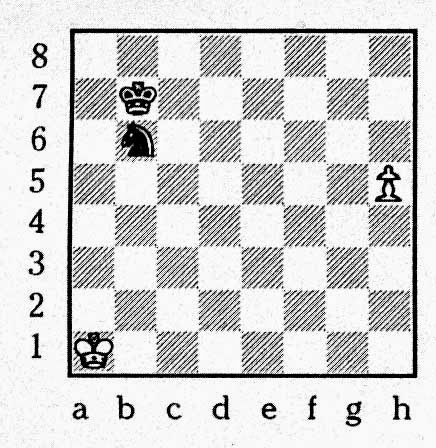
White is about to make a move here. Is the black knight strong or weak? Would it be better or worse to have a bishop on that square?

Answers:

Example AWhite's threat here is to play Nxf7, with a double attack on black's queen and rook. Black should simply castle (0-0). Now if white continues with his "threat," black merely captures the knight and the bishop. That continuation would be
1. . . . 0-0 2. Nxf7 Rxf7 3. Bxf7+ Kxf7
You can see that white has traded bishop and knight for black's rook and pawn. That's about an even exchange, except---in the early part of the game especially---these two pieces are often handier than the rook. Note that white has exchanged his only developed pieces, while black has a bishop and two knights ready to attack.

Example B: Here is an example where a knight is better than a bishop. The bishop is trapped behind its own pawns, while the knight is free to hop in and out of black's position. It will be easy to maneuver the knight to f6, and if black defends the pawn at h7 with his king, white's king will enter black's position by way of c5 or e5, with decisive effect.

Example CThe tables turn; black's knight moves so slowly that after 1. h6, the pawn cannot be prevented from reaching the eighth rank and being promoted. If black has a bishop on b6 instead of the knight, he could answer 1. h6 with 1. . . . Bd4+, when the bishopwould control the crucial square h8.

by International Grandmaster Arthur Bisguier


Saturday, 18 October 2014

Top Ten Tips to Winning Chess (Tip 3)

 Have a plan
       

If you threaten something here in one move, something over there in the next move, and so forth, your opponent will have an easy time defending. Your pieces have to work together to be effective. Just imagine each instrument in an orchestra playing a different tune!

When you develop a plan, your men can work in harmony. For example, you might plan to attack your opponent's king; one piece alone probably wouldn't be able to do much, but the combined strength of several pieces makes a powerful attacking force. Another plan could be taking control of all the squares in a particular area of the board.
The chess men are your "team"; to be a good "coach," you have to use all of their strengths together.
White to move

Look at this position carefully. What would be a good plan for white? What moves would be involved in carrying out this plan?

Answer:
 One good plan for white here would be an attack on black's king. Once he has decided to do this, white should figure out how to bring his pieces to that area of the board. After 1. f4, for example, white can bring his rook to f3 and then to g3 or h3, where it would exert pressure around black's king.

By International Grandmaster Arthur Bisguier


Thursday, 25 September 2014

How to convert “a better position” into a WIN?

Google+
While playing a chess game, quite often you can obtain a SUPERIOR position.
  • It could happen thanks to your good opening preparation.
  • Sometimes your opponent plays badly.
After that you face the famous question in chess: “How to win a won game?”question-mark-300x300
This is not as simple as it seems. An opponent gets tricky and tries to mix the things up. Often you have to play precise moves under time pressure. Then you can spoil a good game, not getting a well-deserved win.
Of course you can blame “that lucky guy” (your opponent) for that, or grieve for“an oversight in time trouble”. That’s what most players do in such cases :)
However, obviously there’s a better option. You can learn appropriate techniques and always finish your opponents off! Look at “chess killers” like Topalov, Carlsen, Adams etc. In a worse position, nobody can escape from them.
killers
If your wish to acquire those skills of “a chess killer” – you are welcome to join my webinar on Saturday 27 September (4p.m., BST). You can get all the details and sign up for the webinar here:
green-fancy-line-hi

Good News: join the webinar for FREE!

The webinar’s price is really small compared to the skills and results you’ll obtain. However, I know that some of the students live in developing countries and can’t afford any additional expenses.
I’ve thought about what I can do for such students and have come up with a good idea! Help us spread the word about Remote Chess Academy, and you’ll get your ticket FOR FREE.
That’s really easy, and I hope that this time everyone will be happy! :)

<< Join GM Smirnov’s webinar FOR FREE >>


green-fancy-line-hi

Now let’s check how you should NOT play in won positions :)

Caruana – NakamuraCaruana-NakamuraWhite’s turn
White is a pawn up and is pressuring Black’s position hardly. It’s almost winning.How to turn that “almost winning” into a real full score? What would you play as White?
Actually there are even a few ways for a quick win. You might be surprised to know that Caruana (rated 2801!) – managed to drew it!
After you came up with your own solution, please, check the actual game here:LINK
P.S. This time I allow FREE entry for my webinar, while there are only 100 seats available. It’s not that much compared to around 25,000 of my subscribers :) Hurry up!

Thursday, 18 September 2014

Disaster in the Opening

IM Alex Kundin has prepared a new lesson for you: “Disaster in the Opening”. You’ll learn useful opening concepts while enjoying a really nice attacking game!


Have you enjoyed the final position of the game from the video? It’s really cool, doesn’t it? :)
Have YOU ever experienced huge troubles right in an opening? That’s quite normal actually, even strong players fall into opening traps from time to time. Club players fall apart in an opening on a regular basis :)
In this lesson you’ve observed 1 interesting example of an opening catastrophe. If you wish to train and improve your practical skills in this area, you are welcome to join Alex Kundin’s webinar “Chess Opening Disasters and Traps”on Sunday, 21 September at 4pm BST.
In this training session you will improve your opening skills, preventing opening disasters in your games. In addition to that, Alex will reveal the most effectiveopening traps beginners always fall for!
Webinar-Kundin


click here to know more 


Monday, 1 September 2014

Blunder of the day

Blunder Of the Day:Right now both the kings are safe but in the near future Black can get his queen to the f4 square which after white cannot keep his king safe.

KARJAKIN – LOTOV


In this positon white played Rd3… But is it the good move? Try to find the best way!

After you have come up with your solution, you may compare your results by looking at the Answer Here


Tuesday, 19 August 2014

The Greatest Chess Moves of 2014

  Today you’ll see one of the most exciting chess moves ever played. Moreover, you’ll learn a couple of practical rules about a king safety, pawn storms, opposite-side castles and much more.


    Monday, 18 August 2014

    How to find a good chess coach?

    I now have huge experience both as a chess student and as a teacher. So let me give you some hints.
    A private chess coach should perform the following things for you:
    1. Analyse your games and detect what you need to work on.
    2. Develop your training plan.
    3. Make on-line or real lessons.
    4. Give you home tasks.
    5. Answer your questions that arise via e-mails.
    6. Check your last home task and provide feedback on your work.
    7. Prepare a next on-line/real lesson based on your training plan and the current needs (that have been detected during items 1 and 5-6).
    8. Think about your overall progress; make necessary corrections in your training plan.
    9. Plan your participation in tournaments.
    10. Keep track of the current situation in chess (read chess news, observe main tournaments, notice new tendencies, popular openings, etc.).
    A private chess coach should perform all of these tasks regularly, even if you have only one chess class a week!
    By using the above list of items, it will be easier for you to evaluate a certain coach and to decide if he/she is a suitable one for you.
    Nowadays there are many web-sites which offer you the services of various chess coaches. Recently I visited one such site and read coaches’ descriptions. Some of them write something like “I am a very popular coach and I have 50+ private students”. I don’t know whether to laugh or cry at this…
    Take a look at our list above. Is that possible to perform it for 50 students? Of course NOT!
    In fact “50+ students” means that this person teaches all his students extremely superficially, and he spits upon them all! Does he really think this is his positive side? LOL
    Let’s move on to the next piece of advice:
    A private chess teacher should be a COACH
    It’s not a joke. :)
    A strong player (IM or GM) can show you some opening lines, can play with you, BUT he can’t be your teacher.
    Is he going to perform the coach’s duties (see our list above)? Of course not! He is not even aware of these duties…
    Can a GM really understand your current problems and needs? Well, he was in your situation; HOWEVER, maybe it was 50 years ago!!
    Another example is that a chess coach must collect useful games/positions that are suitable for training in a certain topic. Does a chess player have such collections for every important topic? No! He simply doesn’t need it.
    There is a HUGE difference between being a chess player and a chess teacher. It requires different skills and knowledge. That’s why quite a lot of chess “coaches”, unfortunately, have no idea of how to teach.
    So when you are looking for a private coach – select a real COACH.
    ————————>
    We’ve been talking about chess coaches, and I hope you are now much wiser about such matters. Now let’s take a look at a STUDENT. There’s one important thing that I’d like to emphasise here.
    A student usually does NOT know what he/she really needs.
    “To know the road ahead, ask those coming back”.

    How can you know what you need in order to advance to the next level,
    if you have never even been on that next level?
    Naturally, you enjoy those parts of the game in which you perform well. And you may dislike those parts of the game that you are failing in. This is normal for all chess players.
    Now, if you dislike defence, and you don’t know this topic well and it seems hard and uncomfortable for you – you’ll never master it. So here is where a coach should come and force you to do what you don’t want to do (the things he knows you NEED and MUST do). This will eliminate your weakness, will bring you nice victories and… you’ll start enjoying  defence! :)
    A student usually does NOT know what he/she really needs.
    This is reality. You can admit it and go forward, or stick with your delusions. The choice is yours.
    I recommend that you find a good coach and then rely on him.
    Otherwise you’ll end up being in the same situation as most of other chess players. Here’s the most typical scenario: a coach who doesn’t know how to teach, satisfies the wishes of a student who doesn’t know what he needs.
    Sadly, this is the most precise description of most chess lessons out there;, and it is also why a majority of players suffer from little and unstable progress.
    However, now you have a better alternative! :) You can follow the advice from this article and be ahead of the crowd!
    If you don’t have good coaches in your area (or if they are simply too expensive for you) – you may also use my course “Self-taught Grandmaster”. It will act as a substitute for your coach and will allow you to organise for yourself an effective self-training process.

    Sunday, 17 August 2014

    Your Winning Plan

    “Do you want to reach the HIGHEST chess goals?”
    “Do you want to become not just a strong player,but an EXTREMELY strong one?”
    “Then use “Your Winning Plan” –the most direct way for a chess success!”
    What is the main factor of success in chess?
    Chess is inherently a strategic game. That’s why strategic skills are the most important thing in chess. They allow you to understand what you should do in any position. Chess players usually call it “a chess understanding”.
    In fact it is not so difficult to study some opening lines or theoretical endgame positions. Players experience biggest problems in complex middlegame positions, when they are not sure what to do.
    Please, remember the strong chess players you know. How do they win against weaker players? They create complex strategic positions and gradually overplay an opponent. They use their better chess understanding.
    So what is the problem?
    Everyone heard about “a chess understanding”. So why didn’t everyone study it? There are 2 main reasons:
    1) Most players don’t know what “a chess understanding” actually is.
    A chess understanding mainly implies your planning skills. If you understand a position, it means that you know what to do here. Thus it means that you can find the right plan.
    2) There are no educational materials about it.
    It is the hardest topic really. It is very difficult to systematize knowledge about a middlegame planning and to integrate them in a clear practical system.
    That’s why 99% of authors even don’t try to do it.How many chess books do you know, which offer an integrate system of a middlegame play?
    Ok, Nimczowitsch’s “My system” is pertinent. Is there anything else? Well, there are a few other similar books, but anyway it is a very short list.
    Nimczowitsch did a great work certainly. However his system is not full and quite difficult for a practical usage (even Nimczowitsch had some problems with that Laughing). Also a lot of time has gone since that time. Modern chess has developed a lot.
    That’s why I decided to create the course
    “Your Winning Plan”.
    It took a long time and a lot of efforts to create such product. With pride I present you the final result.
    The course “Your Winning Plan” gives you an integrate system of a middlegame planningUsing this unique method you will be able to find the right plan in any position.
    This will give you a deep chess understanding and will make you not just a strong player, but an extremely strong one!
    Chess course “Your Winning Plan”
    contains the video lessons.
    Introduction: “Important Generalities”.
    This lesson will give you the essential information about a planning. After a study of this lesson you will know:
    Why different strategic books don’t work in a practical game play.
    Important generalities about a chess strategy.
    Why is planning so important and what most players don’t understand.
    What is the main difference between a strong player and a not so good one?
    What strong players use to beat others?
    What exactly is “a chess understanding” and how to develop it?
    How to predict a game continuation for many moves ahead?
    Lesson-1: “The Best Time for a Planning”.
    In chess books you have probably seen the recommendation “to compose a plan in critical positions”. However they don’t say how to detect those critical positions. That’s why this trite rule is useless.
    I will be telling you how Grandmasters really think in a practical game.
    You will know the specific tips, which you will be able to apply right after a study of this lesson.
    When should you compose a plan?
    What should you do, when you don’t know how to play?
    Typical mistakes of 95% of chess players.
    How to simplify your thinking process and to make it more effective at the same time.
    How Grandmasters find right moves so quickly?
    4 type of situations when you should compose a plan.
    What is a guideline in a planning?
    Lesson-2: “How to Compose a Winning Plan”.
    In this lesson I will tell you what exactly you should do and exactly how you should think to create the right plan.
    The universal scheme, which allows finding the best plan in ANY position.
    Which plan is the best in most positions?
    The most important strategic rules regarding to the planning.
    3 types of situations when you should attack on a side.
    How to detect whether you should worry about an opponent’s plan or not?
    Why the aggressive attacker players lose regularly? How to avoid their most typical mistake?
    How exactly the center bears influence on a planning?
    Lessons 3-7. Specific plans for different center types.
    Everyone knows about a center and different center types. However, most players don’t know how to use such knowledge in a practical game.
    In the lessons 3-7 we will analyze how the universal scheme of a planning (presented in the previous lessons) works in different typical positions.
    Thus you will get the unique collection of the ready-made plans. In 95% of situations it will be enough for you to simply use one of1 these plans to win a game!
    You will study the important specific rules for positions with different center types:
    How to choose the right plan in any situation?
    When to move pawns and when to avoid pawn moves?
    How to make your plan really effective?
    The best way to exploit the opponent’s weaknesses.
    When it is possible to use a passive defense and when you have to create a counterattack?
    What is wrong in Nimzowitsch’s “My system”?
    The typical mistake in defense.
    The common delusion about a planning.
    When you should play vigorously and when you should not hurry up?
    The practical advices to make your opponent’s life really hard!
    And many more useful tips…
    Lesson-8: “Two Universal Keys”
    In this lesson I will give you 2 universal keys, which are applicable for any position. They will help you not just to create a plan, but to create the most effective plan.
    Often it is enough to only use one of these keys to win a game without any problems.
    Also we will continue training the universal scheme of a plan composition. You will see how it is possible to systematize separate positional rules to remember and to use all of them easily in a practical game.
    This will help you to use your previous knowledge (from your past trainings) most effectively and to get practical effect from them.
    Lesson-9: “How to Realize Your Winning Plan”.
    In the previous lessons we have studied how to find the right plan. In this lesson you will learn how to realize that plan correctly. So you will master these things:
    How Grandmasters always keep their pieces on the best squares?
    How to organize your thinking process to get the best effect?
    3 stages of planning, which you should perform to win a game.
    I will show you in a real time mode how Grandmasters composes plans. You will see that it is not so hard actually (if you know the right way).
    How to figure out the best way for the realization of your plan?
    Lesson-10: “Grandmasters’ Secrets of Planning”.
    Previous lessons were aimed for making you a strong player.This lesson will help you to become an EXTREMELY strong player!These advices are your guide “how to be on the TOP”.
    This is probably the most powerful part of the course. I have never shared these secrets with a huge public and I doubt if any other GM ever decide to do it.
    Why Grandmasters realize their plans more successfully than others?
    How Grandmasters deals with hard situations?
    Why Grandmasters win the games even after making mistakes?
    We will compare (in a real time mode) the usual way of thinking (character for most players) and THE BEST way.
    How to bend an opponent to your will?
    Which plans have more chances to be realized?
    Why players often fail in a realization of their plans?
    How to get a really deep understanding of a position?
    How it is possible to get the full control over the situation? This secret allows Grandmasters to get good results ALWAYS (while others suffer from instability).
    What Grandmasters do, when they can’t find the right plan? (4 concrete ways)
    How you can solve the problem of a defense very easily.
    When experienced players offer a draw?
    What Grandmasters do to win an equal position?
    The recommendations for your further improvement.
    And much more…
    Chess course “Your Winning Plan”
    contains the practical part.
    I strongly believe that knowledge that you can’t apply practically are not just useless but actually harmful. Unfortunately this problem is typical for many chess books.
    In the course “Your Winning Plan” you will find only the practical recommendations. You will also know what and exactly how you should do to use these principles in your tournament games.
    The practical part of the course will help you to practice the course’s ideas and to get approptiate practical skills. Thusyou will improve your chess skills and will start winning more games right after a study of the course.
    The practical part of the course contains:
    106 special tasks and games for your training.
    We will start from quite easy situations and then go to examples on the top Grandmasters’ level! After that you will be able to find your winning plan in any position.
    The detailed instructions about what and how exactly you should train.
    It will help you to train yourself properly and to get the best effect from the program.
    The Grandmasters’ thinking process (planning) in a real-time mode.
    So you will be able to copy the Grandmasters’ thinking process and to get similar practical results!

    So when you start to study the course,
    you will see the following graphic menu:

    The graphic menu of the course (screenshot)
    While studying the course, besides a chessboard, you will see text presentations which will help you to systematize and learn the course’s materials better.

    Fragment of lesson 1: “The Best Time for a Planning”(screenshot)

    Fragment of lesson 9: “How to Realize Your Winning Plan.” (screenshot)
    Technical information
    • You will get all the programs, necessary for using of the course. So you will definitely be able to open the course and use it properly.
    • The course works under Windows platform only.
    • The duration of the video lessons is 130 minutes.During these 130 minutes, I will be showing you how to use the unique method of finding your winning plan.
    • You will get the text version of every video lesson also. If you like to read more than watch the video – you can do it easily.
    • Even if English is not your first language, you will understand everything clearly. You will hear my voice, watch the video presentation, read the text, and you could simply use a dictionary if needed.
    • You will get your special link for downloading the course after purchasing. So you do NOT need to pay an extra shipping fee and wait for several weeks to get the course. That’s whythe customers receive the course immediately after the purchase.
    • The size of the whole course is approximately 70Mb, so you can download it quite quickly (it depends on your internet connection speed, but it should be less than 30 minutes).
    • If you have any sudden technical problems – contact me and I will help.
    “I Guarantee Your Chess Progress!”
    While reading chess books, I often was wondering how the authors can offer us numerous quantities of abstract rules?? Obviously there is no way to use such information practically. I think that it happens because the authors don’t feel RESPONSIBILITY for their work!
    I give you the PRACTICAL system, which can (and should!) be applied right after the course’s study.
    I am sure that you will REALLY increase your chess power, because this system was already tested by me and my pupils (and it proved its effectiveness!).
    “I am ready to secure my promise
    by 31 days money back guarantee!”
    Moneyback
    THE GUARANTEE:
    Buy the course “Your Winning Plan” now and study it seriously. Learn the video lessons and complete all of the practical part tasks (following the corresponding instructions). Then apply these skills in your practical games.
    If you do not realize (after the study of the course) how to apply the course’s skills, which I explained and if you do not make any progress – then I will refund you 100% of the price. Just contact me via the “contacts” section of this website, and you will receive the money back.
    Unfortunately, if our teaching methods are not suitable for you, you might not be allowed to purchase any of our products in the future. You may read more details in ourrefund policy.
    As usual, I bear responsibility for my work. I give you a firm money back guarantee.So it is a 100% advantageous investment for you, because all the risk is on me.This way, you can actually rip me off, but I believe in your honesty.

    Chess course “Your Winning Plan”
    contains these materials:

    The video lessons (130 minutes).
    The text version of every video lesson (for printing).
    106 special tasks and games for your training.
    The detailed instructions about what and how exactly you should train.
    The concrete examples with commentaries about how exactly you should apply these recommendations.
    All the programs necessary to use the course properly.