Tuesday, 11 November 2014

History of Chess and free webinar videos

Nowadays, chess players are very much focused on their games – to improve their chess skills, reach the highest goals, increase their ratings, win tournaments and so on. But, as a chess player, it is also very important to know about ‘chess’ and how it originated.
That’s why, today, I’m going to provide you with a nice article – “The History of Chess”. Get ready, it’s time to relax a bit and READ about chess. :) Please feel free to share this article with your friends, even those who don’t even play chess, as this is for EVERYONE.


CHESS – A GAME OF ROYALS

ORIGINS OF CHESS AND CHANGES THEREAFTER

According to chess historians, chess is one of the oldest games in existence; it originated around the 6th century AD.
In those times, The Indian Rajah (king) believed that war was the most effective school in which to learn the values of valour, decision-making, endurance,circumspection and bravery. Because of this, it is believed that war was chosen as the model for the game.
war
The most fascinating and frequently repeated story credits the invention of the game to the holy saint Sissa, at the courts of the Indian King Balhait. The King was disturbed by the prevalence of gambling and the addiction to games of pure luck.
Therefore, he summoned Sissa and requested the wise man to create a game that would require pure mental qualities of prudence, foresight, bravery, judgement,endurance, circumspection and analytical and reasoning ability, to oppose the teaching of games in which chance (luck) decided the outcome by the throw of a dice.
dice
At some time thereafter, Sissa returned to the court of the King with a board(ashtapada) consisting of 8 x 8 = 64 squares, with rules not much different from the ones we use today. There were two armies of different colours, each consisting of 32 men, whose object was to capture or slay the king of theopposing army.
board
The ruler was so pleased that he gave the inventor the right to name his prize for the invention. The man, who was very clever, asked the King this: that for the first square of the chess board, he would receive one grain of wheat (or in some tellings, rice), two for the second one, four for the third one, and so forth,doubling the amount each time.
wheatgrain
The sovereign, arithmetically unaware, quickly accepted the inventor’s offer, even getting a little offended by his perceived notion that the inventor was asking for such a low price, and ordered the treasurer to count and hand over the wheat to the inventor.
However, when the treasurer took more than a week to calculate the amount of wheat, the ruler asked him the reason for his tardiness. The treasurer then gave him the result of the calculation and explained that it would take more than all the assets of the kingdom put together to give the inventor his reward.
Let’s calculate the rice grains needed to fill a whole chess board is an 8×8 square, containing 64 squares. If the amount doubles on successive squares, then the sum of grains on all 64 squares is: 9,223,372,036,854,775,808 on the 64th square and atotal of 18,446,744,073,709,551,615 for the whole board.
That’s about 18 billion. So if a bag of rice contained a billion grains, you would need 18 billion such bags. Actually, a real bag of rice weighing 100 lbs has less than 3 million grains.
TO BE CONTINUED…..
I don’t wish to drag out the length of this article, so we’ll continue the rest of“Chess History” in the next part.


watch our premium webinar videos here


Thursday, 23 October 2014

Top Ten Tips to Winning Chess - Know what the pieces are worth


When you are considering giving up some of your pieces for some of your opponent's, you should think about the values of the men, and not just how many each player possesses. The player whose men add up to a greater value will usually have the advantage. So a crucial step in making decisions is to add up the material, or value, of each player's men.
The pawn is the least valuable piece, so it is a convenient unit of measure. It moves slowly, and can never go backward.
Knights and bishops are approximately equal, worth about three pawns each. The knight is the only piece that can jump over other men. The bishops are speedier, but each one can reach only half the squares.
A rook moves quickly and can reach every square; its value is five pawns. A combination of two minor pieces (knights and bishops) can often subdue a rook.
A queen is worth nine pawns, almost as much as two rooks. It can move to the greatest number of squares in most positions.
The king can be a valuable fighter, too, but we do not evaluate its strength because it cannot be traded.

Example A
Black to move
Here's a harder problem that requires you to use several of the tips you've read about so far. Pretend you're playing black in this position. First of all, what is white's threat? Second, what move should you make to meet this threat? Finally, if white went ahead with his "threat" even after you move, what would be the result?

Example B
We know that a knight and a bishop are usually worth about the same. Which would you say is stronger in this position?

Example C
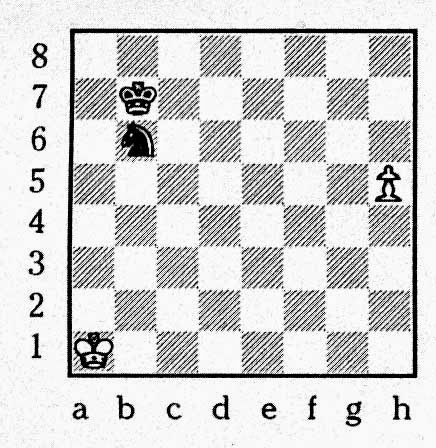
White to move

White is about to make a move here. Is the black knight strong or weak? Would it be better or worse to have a bishop on that square?

Answers:

Example A: White's threat here is to play Nxf7, with a double attack on black's queen and rook. Black should simply castle (0-0). Now if white continues with his "threat," black merely captures the knight and the bishop. That continuation would be
1. . . . 0-0 2. Nxf7 Rxf7 3. Bxf7+ Kxf7
You can see that white has traded bishop and knight for black's rook and pawn. That's about an even exchange, except---in the early part of the game especially---these two pieces are often handier than the rook. Note that white has exchanged his only developed pieces, while black has a bishop and two knights ready to attack.

Example B: Here is an example where a knight is better than a bishop. The bishop is trapped behind its own pawns, while the knight is free to hop in and out of black's position. It will be easy to maneuver the knight to f6, and if black defends the pawn at h7 with his king, white's king will enter black's position by way of c5 or e5, with decisive effect.

Example C: The tables turn; black's knight moves so slowly that after 1. h6, the pawn cannot be prevented from reaching the eighth rank and being promoted. If black has a bishop on b6 instead of the knight, he could answer 1. h6 with 1. . . . Bd4+, when the bishopwould control the crucial square h8.

by International Grandmaster Arthur Bisguier


Saturday, 18 October 2014

Top Ten Tips to Winning Chess (Tip 3)

 Have a plan
       

If you threaten something here in one move, something over there in the next move, and so forth, your opponent will have an easy time defending. Your pieces have to work together to be effective. Just imagine each instrument in an orchestra playing a different tune!

When you develop a plan, your men can work in harmony. For example, you might plan to attack your opponent's king; one piece alone probably wouldn't be able to do much, but the combined strength of several pieces makes a powerful attacking force. Another plan could be taking control of all the squares in a particular area of the board.
The chess men are your "team"; to be a good "coach," you have to use all of their strengths together.
White to move

Look at this position carefully. What would be a good plan for white? What moves would be involved in carrying out this plan?

Answer:
 One good plan for white here would be an attack on black's king. Once he has decided to do this, white should figure out how to bring his pieces to that area of the board. After 1. f4, for example, white can bring his rook to f3 and then to g3 or h3, where it would exert pressure around black's king.

By International Grandmaster Arthur Bisguier


Tuesday, 14 October 2014

Top Ten Tips to Winning Chess (Tip 2)


 Make the best possible move:
When you are considering a move, ask yourself these questions:
  1. Will the piece I'm moving go to a better square than the one it's on now?
  2. Can I improve my position even more by increasing the effectiveness of a different piece?
  3. Does this move help to defend against my opponent's threats?
  4. Will the piece I move be safe on its new square?
    1. If it's a pawn, consider: Can I keep it protected from attack?
    2. If it's another piece, consider: Can the enemy drive itaway, thus making me lose valuable time?

Even if your intended move has good points, it may not be the best move at that moment. Emanuel Lasker, a former world champion, said: "When you see a good move, wait---look for a better one!" Following this advice is bound to improve your chess.

White to move

You're white in this position. Black has just played cxd4 and is temporarily a pawn ahead. What's the best move you can make? Don't be too hasty!


Answer:
White can win his pawn back immediately with a move like 1. Nbxd4. But did you look for a better move? By playing 1. Nc7+, you can win black's queen!

by International Grandmaster Arthur Bisguier


Sunday, 12 October 2014

Top Ten Tips to Winning Chess

Chess is a game of strategy and tactics. Each player commands an army of 16 chessmen --- pawns and other pieces (the king, queen, bishops, knights, and rooks).
A well-played chess game has three stages. In the opening, the players bring out their forces in preparation for combat. The middlegame begins as the players maneuver for position and carry out attacks and counterattacks. The final stage is the endgame when, with fewer pawns and pieces left on the board, it is safer for the kings to come out and join the final battle.
As play proceeds, each player will capture some of the opponent's men; often, the capturing pieces are immediately recaptured. As long as the piece a player gives up is generally equal to the piece he gets in return, we say the players are exchanging. If you unintentionally place a piece where it can be captured without getting a piece of equal value in return, we say that you put that piece en prise. (This is a French term that literally means "in take.") Sometimes a player may place a piece en prise in order to trick an opponent. If the opponent captures the offered man, it may leave him open to attack.

You're Ready to Go!
It's time for you to take a look at these ten tips to help you learn some simple ways to win more games:
  1. Look at your opponent's move.
  2. Make the best possible move.
  3. Have a plan.
  4. Know what the pieces are worth.
  5. Develop quickly and well.
  6. Control the center.
  7. Keep your king safe.
  8. Know when to trade pieces.
  9. Think about the endgame.
  10. Always be alert.
Don't rush. Take your time and be sure to study the examples carefully. Then go out and practice - and have some fun! 


1. Look at your opponent's move!
Every time your opponent makes a move, you should stop and think: Why was that move chosen? Is a piece in danger? Are there any other threats I should watch out for? What sort of plan does my opponent have in mind?
Only by defending against your opponent's threats will you be able to successfully carry out your own strategies. Once you figure out what your opponent is attempting to do, you can play to nip those plans in the bud.
                                                                      
                                                                    
Black to move

Pretend you're playing black in this position. White has just moved his queen to f3. What's the threat? How should you move to meet his threat?

Answer:
White is threatening to play Qxf7 checkmate! Black defends best by moving 1. . . . Nf6. This move meets the threat and develops the knight to a good square.

Keep checking our blog for remaining tips... 
                                                                         
Author
International Grandmaster
Arthur Bisguier


Thursday, 9 October 2014

How to use Chess Engines

Nowadays, most chess players learn and practice chess by using COMPUTERS. There are many chess programs like ChessBase, Fritz, etc., and they have a lot of chess ‘engines’ installed (Rybka, Houdini and so on).
Of course, engines are very strong: they calculate a lot of variations and evaluatea position in not more than a minute. The most important question for YOU, though, is: how to use chess engines PROPERLY? How to utilize the great power of chess programs for your benefit?
In order to answer this question, we’ve invited an active chess player – GM Mikhailo Oleksienko – to join us.
He’s the current Ukrainian Rapid Chess Champion, has won a couple of international tournaments and achieved an awesome 2640 rating in 2014.
This Sunday, 12 October, at 4p.m. BST (London time) you can attend GM Mikhailo Oleksienko’s webinar “Chess engines: how to use them properly?”. You can get all the details and sign up here:

                            <<Sign up for GM Oleksienko’s webinar>>


Monday, 6 October 2014

GM Smirnov’s chess courses are now available in DVDs!


  • DVDs contain high-quality video lessons (HD format). In a downloadable format I had to reduce the video quality to minimize the file size. Now we don’t have this limitation anymore.
  • It’s really easy. You don’t need to download some files, unzip them etc. Now you get a DVD and insert it into your computer – that’s it!
  • It’s safe and convenient. Now you may not worry about a loss of a course (due to your computer crash, virus, accidental file deletion etc). Your course is on a DVD and will always be there.
  • If you have slow or paid internet connection, it’s not a problem anymore (you will NOT need to download a course from the Internet).


  • If you own a certain course already, you can get its DVD version now. You will only pay for a DVD delivery to you (of course you will NOT need to pay for the course again).
If you wish to use this option – please, contact our support team: LINK. You may send us an e-mail to support@chessteacher.zendesk.com as well
  • The price of delivery starts from only $5. The exact price and terms depend on your location. DVD shipment takes from 2 days till a few weeks. Once you select the course, you’ll need to indicate your location, and the system will show you the price of delivery.
From my side, I do NOT charge you anything for a DVD. You only pay to the post (or alternative delivery company) for a DVD creation and shipping to you.
  • You can get my any course on a DVD here: LINK
          If you enjoyed the article, please, write your comment below, and “Follow us” on Google+  using the button on the Right side. Thank you!