Thursday, 4 December 2014

5 Chess Combinations to Solve Today

Tactics training is a very important element for any chess training program. Unless you are at least2400 rated, your tactics vision is not that great and it is something that can dramatically improve your overall level if worked on consistently. Let me give you a simple analogy. Just think that your chess ability is a horse. A weak tactical vision means that your horse has only one leg instead of all 4. Is it easy to ride a one-legged horse?
Anyways, the point I'm trying to make is simple, if you practice enough tactics, you will get a 2nd leg for your horse, then the 3rd one, etc. Today's tactics problems are based on 5 very important combinations that occur often in actual games. Pay attention and give it a shot!
Position 1.
                                                                    White to move and win
Position 2.
position 2
Black to move and win
Position 3.
position 3
Black to move and win

You already understand that a horse with no legs is no good. That's why you are working on tactics. However, the horse not only needs legs, but also it needs strong muscles, stamina, and ideally, an obstacle avoidance capability.  What I mean is that you also need to work on endgames, positional play and attacking skills. All of that you can learn in our training course. Give it a try you have nothing to lose Wink
Position 4.
position 4
Black to move and win
Position 5.
position 5
White to move and win
***
Solutions :


                                                     Webmasters Earn Money Here!


Thursday, 20 November 2014

Anand vs Carlsen World Championship game 8

A difficult decision for Anand of how hard to push in this game. He's only behind 1 pt with 5 to go. If he over pushes & it backfires, the match is practically over. This is why he must be aggressive but play for two results. No need to gamble. Nothing crazy to self destruct. Go with the flow and play with confidence. -Susan Polgar

World Championship Game 8


White: V. Anand (2.792). Black: M. Carlsen (2.863). Queen's Gambit.

1.d4 Nf6 2.c4 e6 3.Nf3 d5 And we have a Queen's Gambit today.
4.Nc3 Be7 5.Bf4 O-O 6.e3 c5 7.dxc5 Bxc5 8.a3 Nc6 This is the old way of playing this line. Anand has two options. 0-0-0 and have a sharper game. Or 0-0 and go for d5 isolated pawn. Anand has to decide how much risks to take.

9.Qc2 Re8 This has to be home prep from Magnus. With this move, black has a threat of e5 then d4. White should probably play 10. Bg5 not to allow black a tempo with e5.


10.Bg5 Be7 In this position, 11. 0-0-0 has to be in consideration. 11. Rd1 is another option if he doesn't want a sharper game.

11.Rd1 Qa5 was immediately played by Magnus. This clearly shows that the idea of 9...Re8, 10...Be7 then 11...Qa5 sequence was well prepared.

12.Bd3 h6 was immediately played by Magnus. He is playing mind games with Anand. He's telling Anand that I'm well prepared for my stuff.

13.Bh4 and again Magnus was quick to respond with

13... cxd4 14.Bxc4 Anand's position is very pleasant. Black must try to get his c8 bishop to b7 via a6 then b5. In spite of playing into Magnus' home prep, Anand has a good and very comfortable position. White is better. I also prefer white.


14... a6 Anand should just simply 0-0. White is doing well. Nothing to worry about.

15.0-0 as expected. And now Magnus has to continue the plan of b5 to get his bishop to b7. +=

15... b5 Anand should put his bishop on a2.

16.Ba2 If 16...b4 then 17. Ne4 then white is doing very good. Therefore, better for Magnus to play 16...Bb7.

16... Bb7 The idea of 16. Ba2 is also to put it on b1 with the Qh7 threat down the line. I expect Anand to take his time here. He has to decide how to proceed. Many choices in this critical moment.

17.Bb1 


17... Rad8 I like 18. Ne4 for Anand now, to get rid of the guard for the h7 square.

18.Bxf6 Bxf6 And now 19. Ne4 is coming next. Anand still has an edge.


19.Ne4 Be7 Anand will probably play Nc5 to get rid of one bishop. Otherwise, black's bishop pair is too strong.

20.Nc5 Bxc5 21. Qxc5 Even though white seems to have space advantage, black should have no problem at this point.

21... b4 Magnus is well prepared. White has not much here. This game is headed to a draw.

22. Rc1 bxa3 23.bxa3 And now Queens are coming off the board.

23... Qxc5 24.Rxc5 Black has nothing to worry about here. The game should end in a draw. Just as yesterday, the game seems to head toward a quick draw. But last game went to 122 moves so you never know with Magnus :)

24... Ne7 25.Rfc1 Rc8 26.Bd3 Red8 White has a slight slight edge but easy draw. The question is will Anand push all the way or will he choose to save energy?

27.Rxc8 And now Magnus should recapture with Rxc8. 99.99% draw. IMO, I think Anand should push, even with no chance to win, just to make a psychological statement that he is not afraid.

27... Rxc8 28.Rxc8 Nxc8 29.Nd2 Nb6 


30.Nb3 Threatening 30. Nc5. Black can stop it with 31...Nd7

30... Nd7 31.Na5 Bc8 32.Kf1 Black is fine. But white has nothing to lose for pushing. Still 99.99% draw.

32... Kf8 33. Ke1 I have no problem if players play until K v K. It's how chess should be played.

33... Ke7 34.Kd2 Kd6 35.Kc3 Ne5 36.Be2 Kc5 Not much has changed with my impression of the outcome. Still 99.99% draw.

37.f4 Nc6 38.
Nxc6 Kxc6 39.Kd4 f6 40.e4 Kd6 Anand has nothing to lose for pushing. He is still slightly better. But do not expect a decisive result.

41.e5+ and they agreed for a draw.


Webmasters Earn Money Here!

Saturday, 15 November 2014

History of Chess Part – 2 and next webinar

“All rook and pawn endgames are drawn” is a chess quote that was often attributed to the great chess player (and doctor) Siegbert Tarrasch.
Siegbert
However, this statement is far from being absolutely true and rook endgames NOT ALWAYS easy to play.
We have invited our friend and VERY strong GM Mikhailo Oleksienkoto teach you how to play rook endgameswith only one pawn left properly. He will show you the general principles to keep in mind, such as how to place your rooks to attack and defend.
Last but not least, he will give you the secrets that you must know that even strong Grandmasters sometimes forget.
 
He’s the current Ukrainian Rapid Chess Champion, has won a couple of international tournaments and achieved an awesome 2640 rating in 2014.
On Saturday, 22 November, at 3p.m. GMT (London time) you can attend GM Mikhailo Oleksienko’s webinar “Intuitional Rook endgames”. You can get all the details and sign up here:
 Webinar-1024x7031
 
Break
Now, let’s get back and continue with the 2nd part of the article “The History of Chess”. (If you’ve missed the 1st part, read it now: LINK.)
————————————————————————————————————-
In this game (chess), there used to be four participants, due to which it was named‘CHATURANGA’, meaning “four bodies” – to be elephants, horses, chariots and foot soldiers. Another name for this game was ‘Ashtapada’, meaning “eight steps”.
Sir William Jones claimed that chess, under the Sanskrit name Chaturanga, was exported from India to Persia in the 6th Century AD and that, by natural corruption, the Persian influence changed the name to Chatrang; but when their country was afterwards taken possession of by the Arabs, who had neither the initial nor the final letter in their alphabet, it was altered further to ‘SHATRANJ’.
The Persian poet Firdousi, in his historical poem The Shahnama, gives an account of the introduction of Shatranj into Persia in the reign of Chosroes I Anushirwan, to whom ambassadors from the sovereign of Hind (India) had come with a chessboard, asking him to solve the secrets of the game if he could or else pay tribute.
The King asked for seven days’ grace, during which time the wise men vainly tried to discover the secret. Finally, a minister of the King took the pieces home and discovered the secret in a day and a night.
Shatranj, as Forbes has pointed out, is a foreign word among the Persians and the Arabians, whereas its natural derivation from the term chaturanga is obvious.
Even the term “checkmate” is derived from the Persian term ‘shah-mat’, which means “the king is dead”. The Sanskrit version of this term would be ‘khastra mruta’.
checkmate
1,400 years went by before the game reached the Western world. The Moors brought it to Spain, while the Italians learned it with remarkable speed from the Saracens.
In India, His Majestic Beneficence and his vizier led the pieces of the King’s army – elephant, horse, chariots, and foot soldiers – into battle. The vizier was to become a queen in the European version of the game, and in the course of history, the Indian elephants metamorphosed into bishops and the chariots into rooks.
One of the set of counters used in chess are ‘the rooks’. A rook is similar to an Indian chariot, protecting the army’s flank.
rook
The term originated from the Persian ‘roth’, which means “soldier”. The Persian word is derived from the Indian term ‘rukh’, which obviously seems to be generated by the Sanskrit word ‘rakshak’, which means “soldier” or “to protect”.
‘The bishop’ amongst the Persians was called ‘pil’ (“elephant”); but the Arabs, not having the letter ‘p’ in their alphabet, wrote it ‘fil’, or with their definite article, ‘al-fil’ (“the elephant”). It was the next in command and had a force assisting acounsellor or minister.
bishop
The elephant was represented by short, upright pieces deeply split on top,symbolising the tusks of these animals. This shape was erroneously interpreted as a foolscap in France and as a bishop’s mitre in Portugal and in many English-speaking countries.
‘The queen’ in Europe, where women did not play the subordinate role assigned to them in the Orient, represented ‘the advisor’.
queen
The queen is the most curvaceous of the modern pieces and has undergone changes in name, sex and power. In Shatranj, this piece was called ‘firz’ or ‘farz’,meaning “counsellor” or “general”.
‘The knight’ as a symbol has come to represent the virtues of chivalry, with its mane and tail exquisitely sculpted and flowing in the breeze. Its features have been delicately accented in the Staunton chess set.
knight
Phidias was the sculptor who worked on the Athenian Parthenon (Elgin Marbles) and is considered the greatest sculptor of Ancient Greece. The Grecian statues were designed in accordance with a set of mathematical proportions and Phidias’ masterpiece was the Parthenon in that city.
The horse became identified with a rider on horseback, “knight” in English,“chevalier” in French, “cavaliere” in Italian, “springer” in German, and so on.
The game framework has remained fixed since that period. It is a square board on which horizontal and vertical lines mark off eight rows of eight cells each.
board
The squares on the traditional boards are always referred to as black and white, the same as chessmen regardless of their actual colour.
Many Jewish and Christian scholars have played chess. The early Christian church condemned the game, which shows the full force of the intolerant medieval mode of thinking prevalent during that period of florescence.
Chess is also played in many Eastern countries, which shows that the game hasglobal appeal.
global chess
For 500 years, chess was played in Europe with the rules inherited from the Muslims. But it took so long to play a whole game that most players confined themselves to solving special positions. During the latter part of the Middle Ages, leading Spanish and Italian players proposed sweeping changes to the rules that shortened the game considerably.
By the end of the 15th century, the new rules had been accepted in all European countries and gradually the Orient followed suit. As players everywhere preferred the shorter game, it transpired that within 100 years it was again played with the same rules but on a near-global basis.
Because of its previous pre-eminence as an intellectual pastime favoured by the upper classes, chess is also called THE ROYAL GAME.
<< THE END >>
P.S. Feel free to share this article with your friends. This is not only for chess players but for EVERYONE.

Friday, 14 November 2014

Top 5 Opening Mistakes Most Chess Players Still Making

Today we will talk about the most common opening mistakes that many chess players around the globe are making subconsciously, without realizing that they are doing something wrong. These mistakes are easy to spot and fix, but you need to know what to look for. Here they are: 

1. Neglecting development

Every chess player knows that the goal of the opening is to develop pieces. A player which does it more efficiently and correctly possesses an advantage in the early middle game. Due to development advantage he can start an attack sooner, without compromising his own king’s safety. These players often win the game in early middle-game with an impressive attack on the king stuck in the center (this is particularly important theme and we pay a lot of attention practicing attack on the king at the center in our chess training course) or struggling from undeveloped pieces.
Sounds great isn’t it? Why many players neglect development and lose games? There are 3 reasons for that:
I. These players get greedy in the opening, grabbing an extra pawn and sacrificing 2-3 important development tempos.
II. These players move one piece multiple times for no good reason. A ‘good reason’ is defined in this case as ability to win a significant amount of material due to some sort of tactics, or to deliver a checkmate.
You should be careful though, since you may waste many important tempos on winning material, which you may never get and end up being far behind in development (aka lost).
III. These players may not know where exactly to develop their pieces (we will talk about this case in one of the sections below).

2. Launching an unprepared attack

Most chess players know that in the opening they supposed to develop pieces, castle, connect the rooks, occupy the center and only then launch an attack. However, if they see a possibility to check an opponent or attack some of his pieces they will go for it even if that does not promise any material gain and requires early queen development.
You should always keep in mind that unprepared attack will delay your development, since you most likely, will have to retreat sooner or later making unnecessary moves and losing tempos.
The best strategy is to complete the development and only then launch an attack.  Otherwise, you can end up playing the opening when your opponent has already entered the middle game (trust me, you don’t want that).

3. Delaying castling

Castling is a very important part of development. Not only castling puts your king to safety but also connects the rooks. There are reasons when it is dangerous and even deadly to castle, but these are more exceptions than general cases, mostly caused by lag in development in the first place.
In most openings it is best to castle quickly and continue on with the game without too much worrying about possibility of the king getting exposed and vulnerable.

4. Not having a middle game plan

The simplest way to play the opening is to develop chess pieces to the positions where they appear stronger. Bishops should be developed on open diagonals, rooks on open files and knights at the center. However, the best approach for playing the opening is to know exactly where to position your pieces according to your middle-game plan.
For example, if you are planning an attack on short side castled opponent’s king you need to place the bishop on a long diagonal, bring up the knight and a queen. You may also want to position the rook in such a way that you can lift it quickly when needed.
When developing pieces always think about your future middle game plan. That way you can save yourself many importanttempos and obtain an advantage. In the final run that could be the difference between checkmating or being checkmated.

5. Playing intuitively

Playing intuitively means making decisions based upon feelings rather than calculations. Unless you are 2500 rated, you probably should not rely on your intuition too much. This is how games end with under 10 moves checkmates.
The rule of thumb is to evaluate the position at least 2-3 moves ahead, also taking into account the basic chess opening principles.

You can also checkout our premium webinar videos here


Webmasters Earn Money Here!

Tuesday, 11 November 2014

History of Chess and free webinar videos

Nowadays, chess players are very much focused on their games – to improve their chess skills, reach the highest goals, increase their ratings, win tournaments and so on. But, as a chess player, it is also very important to know about ‘chess’ and how it originated.
That’s why, today, I’m going to provide you with a nice article – “The History of Chess”. Get ready, it’s time to relax a bit and READ about chess. :) Please feel free to share this article with your friends, even those who don’t even play chess, as this is for EVERYONE.


CHESS – A GAME OF ROYALS

ORIGINS OF CHESS AND CHANGES THEREAFTER

According to chess historians, chess is one of the oldest games in existence; it originated around the 6th century AD.
In those times, The Indian Rajah (king) believed that war was the most effective school in which to learn the values of valour, decision-making, endurance,circumspection and bravery. Because of this, it is believed that war was chosen as the model for the game.
war
The most fascinating and frequently repeated story credits the invention of the game to the holy saint Sissa, at the courts of the Indian King Balhait. The King was disturbed by the prevalence of gambling and the addiction to games of pure luck.
Therefore, he summoned Sissa and requested the wise man to create a game that would require pure mental qualities of prudence, foresight, bravery, judgement,endurance, circumspection and analytical and reasoning ability, to oppose the teaching of games in which chance (luck) decided the outcome by the throw of a dice.
dice
At some time thereafter, Sissa returned to the court of the King with a board(ashtapada) consisting of 8 x 8 = 64 squares, with rules not much different from the ones we use today. There were two armies of different colours, each consisting of 32 men, whose object was to capture or slay the king of theopposing army.
board
The ruler was so pleased that he gave the inventor the right to name his prize for the invention. The man, who was very clever, asked the King this: that for the first square of the chess board, he would receive one grain of wheat (or in some tellings, rice), two for the second one, four for the third one, and so forth,doubling the amount each time.
wheatgrain
The sovereign, arithmetically unaware, quickly accepted the inventor’s offer, even getting a little offended by his perceived notion that the inventor was asking for such a low price, and ordered the treasurer to count and hand over the wheat to the inventor.
However, when the treasurer took more than a week to calculate the amount of wheat, the ruler asked him the reason for his tardiness. The treasurer then gave him the result of the calculation and explained that it would take more than all the assets of the kingdom put together to give the inventor his reward.
Let’s calculate the rice grains needed to fill a whole chess board is an 8×8 square, containing 64 squares. If the amount doubles on successive squares, then the sum of grains on all 64 squares is: 9,223,372,036,854,775,808 on the 64th square and atotal of 18,446,744,073,709,551,615 for the whole board.
That’s about 18 billion. So if a bag of rice contained a billion grains, you would need 18 billion such bags. Actually, a real bag of rice weighing 100 lbs has less than 3 million grains.
TO BE CONTINUED…..
I don’t wish to drag out the length of this article, so we’ll continue the rest of“Chess History” in the next part.


watch our premium webinar videos here


Thursday, 23 October 2014

Top Ten Tips to Winning Chess - Know what the pieces are worth


When you are considering giving up some of your pieces for some of your opponent's, you should think about the values of the men, and not just how many each player possesses. The player whose men add up to a greater value will usually have the advantage. So a crucial step in making decisions is to add up the material, or value, of each player's men.
The pawn is the least valuable piece, so it is a convenient unit of measure. It moves slowly, and can never go backward.
Knights and bishops are approximately equal, worth about three pawns each. The knight is the only piece that can jump over other men. The bishops are speedier, but each one can reach only half the squares.
A rook moves quickly and can reach every square; its value is five pawns. A combination of two minor pieces (knights and bishops) can often subdue a rook.
A queen is worth nine pawns, almost as much as two rooks. It can move to the greatest number of squares in most positions.
The king can be a valuable fighter, too, but we do not evaluate its strength because it cannot be traded.

Example A
Black to move
Here's a harder problem that requires you to use several of the tips you've read about so far. Pretend you're playing black in this position. First of all, what is white's threat? Second, what move should you make to meet this threat? Finally, if white went ahead with his "threat" even after you move, what would be the result?

Example B
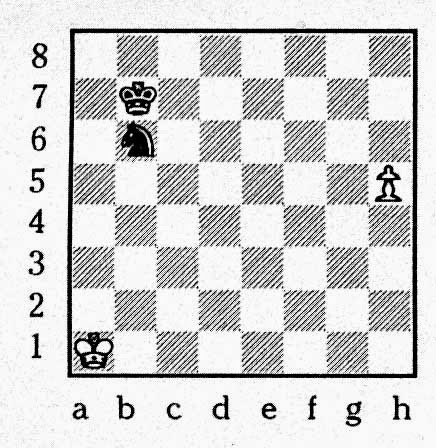
We know that a knight and a bishop are usually worth about the same. Which would you say is stronger in this position?

Example C
White to move

White is about to make a move here. Is the black knight strong or weak? Would it be better or worse to have a bishop on that square?

Answers:

Example A: White's threat here is to play Nxf7, with a double attack on black's queen and rook. Black should simply castle (0-0). Now if white continues with his "threat," black merely captures the knight and the bishop. That continuation would be
1. . . . 0-0 2. Nxf7 Rxf7 3. Bxf7+ Kxf7
You can see that white has traded bishop and knight for black's rook and pawn. That's about an even exchange, except---in the early part of the game especially---these two pieces are often handier than the rook. Note that white has exchanged his only developed pieces, while black has a bishop and two knights ready to attack.

Example B: Here is an example where a knight is better than a bishop. The bishop is trapped behind its own pawns, while the knight is free to hop in and out of black's position. It will be easy to maneuver the knight to f6, and if black defends the pawn at h7 with his king, white's king will enter black's position by way of c5 or e5, with decisive effect.

Example C: The tables turn; black's knight moves so slowly that after 1. h6, the pawn cannot be prevented from reaching the eighth rank and being promoted. If black has a bishop on b6 instead of the knight, he could answer 1. h6 with 1. . . . Bd4+, when the bishopwould control the crucial square h8.

by International Grandmaster Arthur Bisguier


Saturday, 18 October 2014

Top Ten Tips to Winning Chess (Tip 3)

 Have a plan
       

If you threaten something here in one move, something over there in the next move, and so forth, your opponent will have an easy time defending. Your pieces have to work together to be effective. Just imagine each instrument in an orchestra playing a different tune!

When you develop a plan, your men can work in harmony. For example, you might plan to attack your opponent's king; one piece alone probably wouldn't be able to do much, but the combined strength of several pieces makes a powerful attacking force. Another plan could be taking control of all the squares in a particular area of the board.
The chess men are your "team"; to be a good "coach," you have to use all of their strengths together.
White to move

Look at this position carefully. What would be a good plan for white? What moves would be involved in carrying out this plan?

Answer:
 One good plan for white here would be an attack on black's king. Once he has decided to do this, white should figure out how to bring his pieces to that area of the board. After 1. f4, for example, white can bring his rook to f3 and then to g3 or h3, where it would exert pressure around black's king.

By International Grandmaster Arthur Bisguier